Showing posts with label photography. Show all posts

Wednesday, October 12, 2016

The Sensorium of Sight: "The Blind Photographer"

The Blind Photographer: 150 Extraordinary 
Photographs from Around the World
edited by Julian Rothenstein and Mel Gooding, 
published by Princeton Architectural Press, 
2016.
When the Princeton Architectural Press offered me a copy of 
The Blind Photographer: 150 Extraordinary Photographs from Around the World I leaped at the chance to review it. This wonderful book expands my concept of sight and has encouraged me to consider—as I never have—its sensory sources. 

The ideas alone would be enough excitement, but the one-hundred fifty photographs themselves are genuinely remarkable: You won't have to be a student of philosophy to be smitten. These are all different, and not in the way of freakery—curious extension of the limited capacities we attribute to persons we deem deficient. Even did we know nothing about the artists' blindnesses, their unusual perspectives and the concentrations—the committed, bullet-like deliveries of life—make any viewer's heart leap in a new direction. There is indeed a lot more than first meets the eye!

The Blind Photographer, edited by Julian Rothstein and Mel Gooding, is introduced by an essay, "Eyes That Feel," by the Scots novelist, Candia McWilliam. It is a superb piece of art writing, poetic in a way that, I venture, clarifies and informs more successfully than a "scholarly" essay could. Her success lies in leading viewers into the hearts of the artists' goals and challenges. As she discusses a single one of them, McWilliam teaches us how to travel through the surfaces into the images and into the mental and sensory worlds of the photographers.
Untitled. Copyright Ramón Jiménez.


One photo she describes as "a rainbow-fibred mop head with its alert handle and attendant bucket; two bottles, one water, one maybe bleach; the distinction comes into our sinuses as we imagine sightlessly drinking from the wrong one." 

I see a composition with three centered circles (their volume isn't apparent) of decreasing circumference, shot from an unusual perspective, straight down. The pole appears very securely upright, but by what means? It's too far from the cameraman for him to hold it. We see the artist's feet: It takes two hands to grip the camera and shoot straight down.

If we with sight put ourselves in the blind photographer's shoes—which we are certainly invited to do—the image is transformed. Then, off course, drinking from a circle makes sense. If I were blind, I would lack the perception of volume. A circle and a sphere would look the same to me. Jimenez was informed by that smell of bleach: In fact, for him, this whole composition is formed around the sensory perceptions of standing on a freshly-mopped, possibly wet, tile floor. 

It's not only the smell of bleach, but the feel of the floor under his feet, something he is sensitive to in ways we sighted can only begin to imagine. Will he slip? The stability of the mop pole takes on a significance beyond, "How did he do that?" The floor, which few of us think much about, must be the center of the world for the blind. Jimenez shows what he knows about the floor from the smell, and from the shapes he perceives both literally and poetically. In his shoes, the photograph is a different work than the one we see at a distance, with vision only. We are welcome to a new way of knowing, and a new, enriched way of seeing.

Untitled. Copyright Alicia Meléndez.
"To look closely at these photographs is to be humanly remade by the refusal of these photographers to objectify an atom of the experienced world, recorded here with what we could call felt sight," McWilliam writes.

That's a fascinating thought: that these photographs don't objectify their subjects but bring them to us through direct experience. If we experience Alicia Melendez's photograph of her shoes rather than look at it, it becomes almost tremblingly intimate. I'm used to seeing images of women's shoes as glamorous and sexy products that place their wearers miraculously "above" any impediments that the earthbound suffer. 

Melendez's shoes are shown at floor level, on the floor, as if they walk toward us motivated by the power invested in them by their wearer, or as if they have become pets that come when called. They are scuffed, stretched out, water-worn and yes, we can smell them too. The shoes are a self-portrait in the sense that they communicate their importance and the experience that creates their importance. They are solid on the floor and through puddles; they are durable and flexible and dependable. They are important to her security and to her ability to move independently in the world, photographed as they are on a rooftop, in a space between the outdoors and indoors.

Untitled. Copyright Gerardo Ramirez Pfizer
Gerardo Ramirez Pfizer shot his hand of bananas in much the same way as Alicia Melendez portrayed her shoes: nose-to-nose. This extreme close-up is seen a lot in the book and no doubt reflect the necessity of the partially-sighted to hold things close to examine them. This results in unusual and striking perspectives, like this one of looming, aggressive bananas. Are they sighted with black eyes that are examining us? Are they creeping up on us? These are experienced bananas, fruit to which we bear a relationship. It's not sitting
Untitled. Copyright Aaron Ramos. Another fine example of
the close examination. Did sound lead Ramos to the subject?
Imagine the patience and slow movement required to get
this shot.

there waiting to be consumed. It's something individual out there in a world where objects do not automatically have value or precedence one over another; most are experienced singly. Right now, it's bananas. Let's close in. Maybe they'll open up to us.

McWilliam's "felt sight" has particular interest for the blind photographer's relation to human subjects, of which this collection has many wonderful examples. I'm fascinated by this photo of a seated female. It feels very traditional and
Untitled. Copyright Mickel Smithen
 formal: Just look at her pose, her position within the picture frame, and her contemplative, far-away expression. But I find her expression a little odd because the pupils of her eyes are unusually dilated. Possibly she too is blind.

Once more, the possibilities of blindness—now on the parts of both photographer and subject—reorient our view of the image. Is it or is it not a formal portrait, for instance. 

Did the subject "dress for the occasion?" Are the brightly colored clothes special, or what a partially-sighted woman chooses on a daily basis? Is her expression the expression she assumes when she is between tasks or waiting, since she may not be acquainted with the wide variety of facial signals the sighted use for tiny distinctions of mood or occasion? To the photographer, this may be a woman in a chair and not at all a formal portrait. Did it matter to her that she was being photographed? Would she be interested in the resulting picture—or vain about the outcome?

On the other hand, McWilliam points out that blind photographers never point and shoot; that all of their work is accomplished over a longer period of time than most sighted photographers take. Setting up the equipment, let alone the shot, is especially time-consuming without the aid of vision.

So we may be sure that Smithen at least had the chair waiting for an occupant. For her? For a series of people? For whoever sat down? This shoot was purposeful, but to what degree the shoot depended on this subject is uncertain, particularly since the image is untitled.
Untitled. Copyright Tanvir Bush.
The variety of photographs in The Blind Photographer is surprising and wonderful, far too many to touch in a review. But it would be a pity not to share this from a series of photographs of this young man lifting this weight. There are several such series, in which a sighted subject playfully performs some act of athletic skill for the photographer. They "show off" and as they do, and they keep their eyes directly on the camera in a way I suspect they would not if they were certain that the photographer could see them. In this shot, the young man seems to be measuring the photographer's capacity as much as he is demonstrating his own strength. He appears to have no doubt about the latter: It is a means for getting a peek at the blind person with the camera. Which is looking at him? The person or the machine? Is either more imbued with sight than the other? Or does each confer sight upon the other?

The photographer's blindness is disinhibiting for the sighted subject here and in other photographs. They express their curiosity, their swagger, their uninhibited joy in their accomplishment and activity in ways I haven't experienced in other photographs. Go to the library and ask for this book: Take a look. It is so much fun!

Not being familiar with Candia McWilliam, I looked her up. Her writing in The Blind Photographer is exceptionally fine and insightful. I shouldn't have been surprised to find that she is blind. Apparently her eyes function, but ten years ago she contracted blepharospasm, a disease that makes it impossible for the eyelids to open. She writes by holding an eyelid open with one hand and typing with the other. Her memoir, What to Look for in Winter: A Memoir in Blindness (2010), is on my list.

Sunday, May 24, 2015

"Catherine Opie: Portraits and Landscapes" at the Wexner Center for the Arts

I think that Thomas Edison has already been installed to replace William Allen as an icon of Ohio in the Capitol's Statuary Hall. Had I only known that ours is Catherine Opie's home state, I'd have done something to see her enshrined instead next to James Garfield as the a representative of Ohio's glory. Move over, second-tier presidents, when we have artists of true stature and vision.


 Catherine Opie, Miranda, 2013. Pigment print, 33 x 25 in. ©Catherine Opie, image courtesy the artist
 and Regen Projects, Los Angeles 
Certainly Opie's photographs in Portraits and Landscapes, showing at the Wexner Center in Columbus until August 2, would be at home in the proudest marble and columned traditional setting. If we were in the 17th century galleries of a great European museum, surely our feelings would be much like the ones we experience as we move at considered pace through this show.

Each of Opie's sitters appears before a background of profound, impenetrable black. Whether we register that as a blankness or as infinite depth, the effect is in either case the same. It places the subject in a timeless  three-dimensional space entirely his or her own, unrelated to any other place or moment.

The effect is to sculpt the figure out of this medium of black. The light not only defines the subject's features, emphasizing some over others, but frees the form from the darkness as sculptures are said to free figures from great pieces of stone. So, through two galleries of portraits, each figure is captured at a second birth, born not of flesh, but of mind, effort, and imagination These are individuals sprung like Athena from Zeus's head, fully grown and mature. ( An interesting comparison can be made at http://www.modigliani-drawings.com/nude%20in%20profile.htm .)

In her portrait, Miranda wears a gown of almost Quakerish simplicity and understatement. Its claret color and her red hair mediate between blackness and the luminous skin and blue eyes that shine from her steady, resolute expression. Beauty can be a poisoned gift. Here, beauty is neither disguised nor avoided; its possessor can carry the weight with chin slightly lifted, directly returning the viewer's gaze. The image portrays the strength, stature, and balance of a flawlessly beautiful woman with nothing—not even her perfect face—to hide.

Miranda, a three-quarter standing portrait of a woman of noble bearing, is clearly related to a long tradition of Western portraiture, evident in any museum one cares to visit. While this particular woman captivates us with her seriousness and beauty, we also know that, individual, her photographer places her among a class of persons demanding our highest respect. The setting, the attention to details, the lighting all tell us so. Do we really need to know who she is? Here is a distinguished individual who is also a participant in the centuries-old tradition of women posed for posterity. She is one; she is another one.

When we visit museum galleries hung with grand and stirring portraits of Renaissance, Enlightenment, or nineteenth century royalty, clergy, poets, and concubines, how often do we know who those portrayed persons were, or what they accomplished in the world? Certainly not as often as we'd like. King George? Henry? And what number? Not a clue! Yet we interpret the images through our understanding, general knowledge, and imaginations via the art itself, through conventions and deviations from them; from our own reactions to images of luxury, eccentricity, and beauty. We react to the story the artist has told and we create the central figure to satisfy our use of the painting. Ahistorical? Anachronistic? Yes. Utterly commonplace? Yes again.

In fact, we do the same thing with contemporary portraits simply because we don't know everyone who is thought to be important to image-makers. Nor are we supposed to. In this series of portraits, Opie identifies her subjects by first names only. How they were posed appears to have been largely up to the artist, who received lovely testimonials from many of her subjects for the generous or enlightening experiences they had with her. As recounted in gallery notes, the artist Kara Walker remarked that before many scheduled portrait sessions, she has been less than at her best: "There are a handful of images by well-known artists out there of me at my darkest, lowest points. Cathy's manner and the resultant images show me feeling cool, collected, showing my muscles…I felt a rush of ownership or at least fellowship—that we were going to endeavor to correct this past."


Catherine Opie, Mary, 2013. Pigment print, 50 x 38.4. ©Catherine Opie.  Image courtesy the artist and Regen Projects, Los Angeles 

So, yes, Opie's subjects are eminent people, contemporary artists working in the avant garde of visual arts, literature, performance, and music. Even though many will be recognized by a relatively small audience, they are nonetheless constantly imaged. Miranda, above, is the filmmaker/performance artist/writer/actor Miranda July. If you haven't seen her before, just Google for her image: There are pages of them. It's a worthwhile exercise in understanding the difference between a picture and a portrait.

In the present day, pictures are everywhere by accident and by design. The tradition of grand portraits in which Opie places this series derives from times in which images of the great were rare and precious. A painted portrait of Voltaire would become the basis for engravings, which could be printed and disseminated at low cost. But the world was not saturated by an infinite flow of unique images of a single eminent person who was redecorated and whose personality was recast daily. There was a constancy about the central identities of intellectuals and artists.These portraits, in this form, reclaim that idea of constancy. 

To the extent that Opie's portraits help define and settle identities, she uses visual tradition as a structure upon which she arranges the ideas, works, and core identities of the individuals portrayed. The black background, the exquisitely controlled lighting, the dignity of the posing, the shapes of the portraits: These form the traditional framework that assure a place of honor. Within that framework, the individual is exactly as portrayed—nude or clothed; regal or workmanly; facing forward or back to us; looking into the distance, or daring us to return a gimlet gaze.

Catherine Opie, Idexa, 2012. Pigment print, 50 x 38.4. ©Catherine Opie.  Image courtesy the artist and Regen Projects, Los Angeles 

While Miranda's classicism provides studied definition to a woman whose image is ubiquitous and casually broadcast, in Mary and Idexa,  Opie uses conventions to bring the temperature of uncommon images down. Tradition soothes expectations and we are eased into accepting the differences in purpose and outlook revealed in these portraits. Formality does not stifle outrage, but it is a leveler; it brings discussion back to a home base.The women depicted here are not women with traditional self-awareness or lives. But who they are and who they wish to reveal are who we will see in the same dignified ways we would see queens and saints and famous lovers portrayed. 

These two portraits will hang comfortably in haughty halls centuries hence, among the late Maries and Georges and Voltaires; the images will command respect beyond our period and, like all historical images, will require the acts of research and imagination that we are asked to give to the past from our own present. The question cries out: Can we understand the genius of difference in our own time with the acceptance we grant to heroes of the past? Can we imaginatively condense the years it takes gradually to achieve understanding through the mediation of formal visual traditions?


 Catherine Opie, Untitled #5, 2012. Pigment print, 40 x 60 in. ©Catherine Opie, image courtesy the artist and Regen Projects, Los Angeles 

The Portraits in Opie's show are so intense, so detailed and personal that the curator, Bill Horrigan, made the interesting decision to divide the portraits into groups of three or four separated with single, large scale landscapes the artist's. Some of these, like the one above, I am sorry to feel obliged to call a landscape, as I think it is so very open to—so inviting of—free interpretation. But their use is fascinating, contrasting as they do with the entirely unfocused with portraits in which every detail is in sharp focus. Neither is realistic, of course. But the effort the portraits compel from the viewer, with a degree of focus that only incites us to come ever closer—sends one into the landscapes as if suddenly lifted out of stress and sent into cool reverie. It is both relaxing and disorienting, for there is no middle between the two photographic approaches. I like this arrangement better in the first floor gallery, which is larger than the narrow upstairs room. With lots of room to stand back and to take in a whole long wall, the effect of the combination is lovely and its meaning is clear. The closer one is to the works, upstairs, the harder the effectiveness of the contrast is to grasp.

If there is any problem with this show, it's that any single work in it could stand alone as a show in itself. It's an embarrassment of riches to be sure. The portraits are of a size and degree of detail that each is a map of the world, a voyage out far beyond anything you can notice at the outset. Every well-crafted detail is surrounded by a field of more and more subtle and revealing manipulations of Opie's medium. They are captivating and fulfilling—and absurd to present in miniature, in a blog. Don't miss a chance to see them.


Catherine Opie, Hamza, 2013. Pigment print, 33 x 25 in. 
©Catherine Opie, image courtesy the artist and Regen Projects,
 Los Angeles 


Monday, January 26, 2015

Call It Something or Call It Nothing: Maika Carter's Progress

Maika Carter, from Call It Something or Call It Nothing.
View of gallery wall in Maika Carter's Call
It Something or Call It Nothing
In the small Project Room in the Gallery at Columbus College of Art and Design, recent graduate Maika Carter is having her first solo show, Call It Something or Call It Nothing, up through February 20. I haven't seen a lot of publicity for it, but I'm delighted to recognize this work of questioning beauty and maturity.


The show is arranged like eight
chapters of a photographic narrative. Its progression from subject to subject is clearly delineated; the content of each unit is presented in distinct, striking images, and the movement from section to section feels organic. Best of all, the last chapter constitutes a synthesis up of all that has come before. What has it added up to? Something essential and true packed into the the mundane and happenstance? Or an affirmation of meaning in life's trivial accumulation? 
Maika Carter, from Call It Something or Call It Nothing.


The first photographic grouping—of images large and small, matted and pinned in well-considered groupings to the wall—features shoes, mostly empty. The black and white photograph of ballet flats facing one another across a break in the asphalt has the punch of confident simplicity. We've begun a march or a tour, but there's a question of direction and purpose from the first step. How will we fill the shoes, what is the purpose, where will we go? Carter's photographs, black and white mixed with others of saturated, strong color, don't suggest to me ambiguity so much as they suggest the very human condition of eagerness and determination even in want of a map. The images are all bold. Does the confusion of direction among the shoes indicate folly or indecision? Or simply the fact that life offers little direction?

Maika Carter, from Call It Something or Call It Nothing.
We walk to chapter 2 only to find us in the place of the Missing, where things have vanished or are fading from our sight. This is a grouping of photos that arrest you not with a pounding message, but with an ache of sorrow that accumulates as you have to move up close to the many small images gathered around the larger ones. Many of the photographs on these walls are no larger than 3 inches square. When Carter blurs the content, it increases the intimacy between viewer and picture, leading to heightened emotional impact. The picture of the yellow warning tape leading across the unadorned pavement square causes by suggestion more sorrow than would a lurid, graph crime scene shot.
Maika Carter, from Call It Something or Call It Nothing. Group
photo including the artist.


Maika Carter, from Call It Something or Call It
Nothing.


But the next section of  colorful photographs moves us in the way we respond to the scrapbook of a big, happy family. Carter brings us to a large, rambling spread of smiling relatives and friends of several generations—people happy to be together, happy to do what they are doing, feeling special and loved. I feel certain that this passage of the exhibition will leave no viewer unmoved. Carter's casual arrangement works beautifully here, where we feel the high spirits and warmth including us too. I think that it's partially the scale of the pictures and the fact that we have to approach them closely—as if we were indeed perusing a scrapbook—that makes it feel so inclusive. I reacted to these not as to pictures of strangers, but as to people whose happiness I shared. I felt no barrier. The viewer is one of the company, and happy to be be there as a familiar of these people.


Maika Carter, from Call It Something or Call It Nothing.
Collection of friendship photographs.

Are we reading an autobiography or are we a character in the artist's? Are we following a tale of Everyman? The question cannot help but come to mind at many points, but especially as the narrative descends from confident, social well-being to a chapter of literal effacement—a Slough of Despond if you will. 


Maika Carter, from Call It Something or Call It Nothing
Carter gives us many alluring images of humans, but with their faces or head blurred out or cropped from the frame. The smiles, the friendly connections are gone in a new milieu of isolation and anonymity.
Maika Carter, from Call It Something
or Call It Nothing.

The narrative continues through several more chapters that alternate roughly between presence and absence, between happily socialized security and images of vacant, drifting society. 

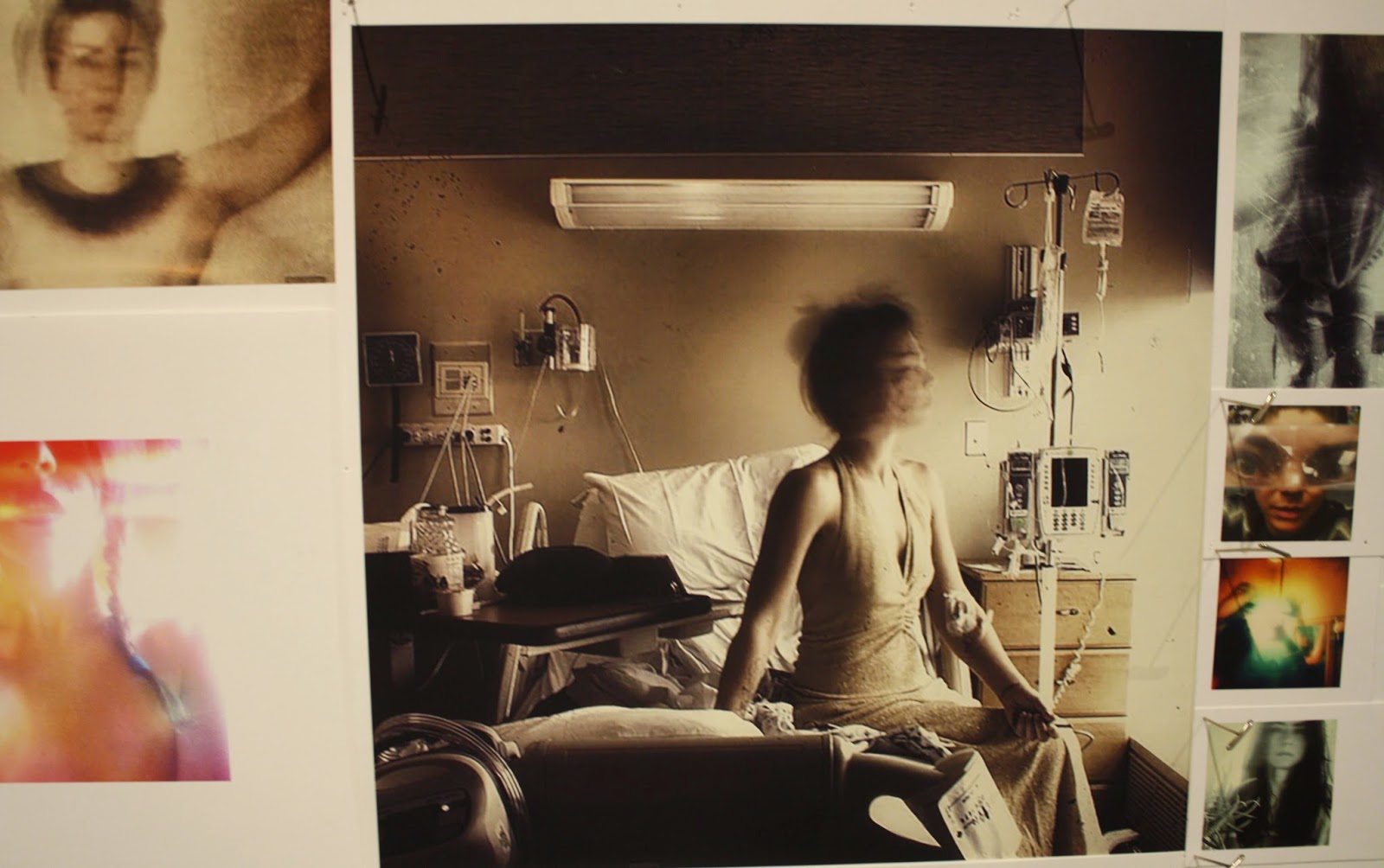
A chapter focused on the photographer herself is particularly arresting. It would be poignant were the pictures not so bold and frank. As usual, many pictures—large and small—are assembled, but the viewer has to think twice to grasp that the subject is the artist, so they must have been staged. Every one of them has the air of complete spontaneity: funny faces, dramatic poses, but of artistic quality far beyond the photo booth. They are so natural, in fact, that they raise doubts about everything that has come before. Maybe the show really has been the work of an anonymous third party.
Maika Carter, from Call It Something or Call It Nothing.

The cluster of self-portraits focus on large, matter of fact images in full color and in sepia, of the artist in the hospital, recovering from abdominal surgery. The brilliantly-well lit hospital room with the bloody tubing emanating from her belly is unnerving except that she faces the camera as if she were in conversation with you, the friend close enough to be visiting. Throughout the show, you have been reeled into her world and point of view and now, here you are, paying a post-op visit, the kind you wouldn't be able to stomach with any but your very best friend.


Maika Carter, from Call It Something or
Call It Nothing.
Maika Carter, from Call It Something or
Call It Nothing.
By the time I arrived at the last section of the show, everything that came before had prepared the way for a rich consideration of the title proposition, Call It Something or Call it Nothing. The photographs in this area switch back and forth until their messages of anxiety and hope at last intuitively merge. The artist wonders, given where she's been and what she's experienced so far, what life is? Something or nothing? Love or anomie? Do we invest in the future? Or do we lie down and see what hits?

Maika Carter, from Call It Something or Call It Nothing.
The landscape Carter has chosen for this final reverie is far from dreamy, bucolic, or reassuring. The images are urban, spray-painted, tattooed, and seem remote from the reassuring sense of middle-class order and safety many of us associate with a life and with a future meaning "something."

I'm not sure that Carter is acquainted with John Bunyon's The Pilgrim's Progress, but in this show I feel a connection with that tale of moral trial and resilience. The artist takes us through eight passages of pleasure, doubt, and grief. Without denying beauty, she doesn't stop to lament when it's absent. A calm, even-handed air of acceptance runs throughout the show, whether we witness happy camaraderie or pictures of lost of identity.

I think Maika Carter's first solo show is a knock-out. She shows her powers as a photographer, as a story-teller with an excellent editorial sense, and as an individual with the wisdom and intuition that make her skills important. I, for one, will be following with great interest an artist who shows such maturity straight out of the box.

Maika Carter, from Call It Something or Call It Nothing.