Showing posts with label art criticism. Show all posts

Monday, August 22, 2016

I Reconsider the Necessity of Criticism

Ray Sasaki speaks trumpet

The work entailed by running a young publishing company has been so all-consuming that I concluded a few months ago that I could no longer devote time to writing Starr Review: that I was overwhelmed and responsible to my authors were sufficient reasons to give it up. I didn’t mention my growing skepticism that it made much of a difference one way or the other whether I wrote or not.

Silly me! I shall pick up my pixels once again on whatever irregular basis I can. My lapse from reviewing has allowed me to conclude that readers or none, I feel compelled to write criticism to reflect and expand the impact of artists I'm moved by—what they think and make. Who can grow without discussion? How can I enjoy art without the time that writing makes me take to consider it deeply, in proportion to the generosity and magnitude of labor that brings art to us?

This weekend past I heard and talked with the brilliant musician and musical thinker, Ray Sasaki who is, among many other things, trumpeter with the Tone Road Ramblers. Ray spoke about the fact that he’s been playing his instrument since he was eight years old. How simply he told his audience that to play his horn is to speak. In essence, he is bilingual and it’s not clear that English is the more fluent language.

This stopped me in my tracks for being so simple, primary, and universally applicable. We often want to be relieved of the work of accepting gifts of art that we have to assemble with toolboxes limited to verbal language. “Artist: Just tell me what you mean! Be your own museum label!”

When Sasaki speaks music, does it matter if I make sense of it with words? Of course it does: that’s what most of us know. Art in all forms is sent out into a verbal world. It’s in the space between musical or visual or spatial language (literary language too!) and our attempts to understand it that meaning, discovery, and love happen. That's the space where criticism helps us appreciate, question, and discuss Sasaki’s sounds, where we can thank him directly or indirectly. In writing, I can lead others to his music and the world of ideas into which he invites us. These are the reasons to write—and to read—criticism. Or “reviews” as single-subject critical pieces are called. (see The Tone Road Ramblers: Always Some Surprises)

Democracy of Book Reviews

Being a publisher now has made me all the more poignantly aware of the dilution of reviewing. In visual art, one has long seen the decline of art reviews in local papers and the brevity of those that appear. Book reviewing, on the other hand, would seem to be undergoing a renaissance, thanks to customer reviews on Amazon’s commercial site and especially reader reviews on Goodreads’ social media network.

Book reviews are central to the literary world. They inform us about meritorious titles, and give us a chance to discuss them in our minds with informed interlocutors. It’s been sad to see book reviews fall away from the weekend sections of city newspapers, or to shrink under niggardly word limits where they do survive. There are fewer than there used to be. So I thought until these days of on-line, popular reviewing.

A book review is a signed essay that describes the work, raises and expatiates upon its themes and connects the work and writer to the wider world. The genre of review flourishing on websites simply summarizes the plot or argument of a work and rates it according to the reader’s feeling of like dislike—five stars or one, thumbs up or down. This isn’t a book review. It’s a book report or, if sufficiently succinct, advertising copy.

Goodreads serves the active and enthusiastic reader as wide-ranging, democratic book club. Readers have the satisfaction of keeping booklists that serve as reading diaries. They are motivated to read more by being in the virtual midst of readers who are always “talking” about books and comparing notes. Readers enjoy the companionship of overlapping communities with similar tastes and enthusiasms, which, in turn may nudge them into broadening their tastes in authors and genres. I think Goodreads has to be a plus for adult reading generally, a club with meetings on any schedule needed and no irresistible fattening noshes.

It’s unfortunate that the posts on Goodreads get called “reviews” since they almost never rise beyond plot summary and a rating based on a personal, eccentric factor. A book receives a “1” because the reader doesn’t like books with lots of characters. Another receives a “5” because the reviewer finds beautiful (for no illustrated reason) the writing that most book critics would deplore as ponderous. In short, analysis, specificity, comparison are hard to find in this world. Authority based on other than taste is rarely present.

Goodreads reviews do reflect the world of “legit” book reviewing in one discouraging way, that being that a few “hot” books are reviewed hundreds of times while books that are less publicized (and continue that way for all the attention lavished on the best-sellers) go relatively unnoticed. The connection between criticism and marketing is as embarrassing as the emperor’s new clothes. While the publishing world is replete with titles, the marketing budget or previous sales of an author’s books are what draw reviewers both popular and professional. No one wants to be seen making a call on an “unimportant” title: Most reviewers are very conservative, and are unlikely to introduce a new title by themselves. It's also hard to turn down a free book received through a well-oiled network.

I asked a NPR host who once spoke in Columbus why all of the many shows on the network reviewed the same one or two books at a time, when there are always so many to choose from. He dodged the question with a laugh.

Is criticism about passing judgment? Rating? Thumbs up or down? Take my word for it? You’ll love it?

Hooray for readers! Hooray for sharing opinions, for reading together, for swapping books, for keeping au courant. But let’s not mistake Goodreads and Amazon book reports and opinion-posting for criticism—that deeper, time-expanding conversation that takes us farther inside a book and into the widening spirals of space, time, and idea around it.


Saturday, August 22, 2015

Reflections on Criticism: Acts of Committed Imagination

Let's take a moment to review. Why do I write art criticism on the internet? 
Ann Starr, from Home Security, 2005,
ink on paper


Reviewing art unasked by a self-constituted audience could be taken as an egotistical overvaluing of my own opinions; the more so since I do this without being employed by a media outlet that might pay me minimally for a certain number of words that illustrate an image or two.  But anyone who is offended can simply ignore rather than challenge the ideas I propose. In a twenty-first century of multitudinous bloggers, the world is awash with opinions for readers to drink deeply or dabble in. There's no curriculum. And essentially, there's no competition.

I write these reviews because they organize for my own sake my reactions to art shows that I see. Writing forces me—forces anybody—to dig deeper. Writing is a certain path to discovery. And what is any art about if not discovery? 

In writing I try to imitate the artist's process of digging in, observing, and solving a sequence of related problems—materials, colors, structure, size, memory, attitude... When I reach a conclusion, it may not be the artist's conclusion, but it will hopefully follow similar logic. Or it will arise from contemplation of the same materials with the opportunities they offer. To write is to shadow; it brings me as close as I can get to the generation of the artworks without having been there in fact.

So, to write reviews—to write criticismis to observe as closely and comprehensively as I can. To observe closely is an act of committed imagination. 

Readers will have noticed by now the way I have allowed the nouns "review" and "criticism" to assume the same space. "Criticism" usually carries the idea of evaluation more heavily than does "review," but both imply evaluation and analysis. 

Neither "review" nor "criticism" means synopsis or description without the addition of the writer's own analysis, evaluation, or insight. A reviewer or a critic has something to share with the audience beyond prose received from a press release and what observations will serve to prove that he/she did indeed visit the site of the show.

"Criticism" is often associated with academic study for whom the intended audience is scholarly or deeply informed. This is why I stick to the term "review." Criticism is popularly thought to be fault-finding and esoteric. There is enough witty, rhetorical criticism, too, that rips apart easy targets and constitutes its own sub-genre of writing to maintain general readers' leeriness of the term. Criticism is seen as a negative act that dismisses the content most people would be interested in. Criticism, as many understand it, focuses only on form, poetics, technique, tradition, and such aspects of art as non-specialist observers might consider secondary. 

While academic conversation is crucial for the advancement of knowledge, and while the work of academic intellectuals is to be respected, I wonder if its influence hasn't stunted the emergence of more practical criticism directed at a general, educated, and eager audience—those of us who visit museums and galleries for pleasure. Even the vocabularies of the premier art magazines are specialized, traceable back to the academy, not to standard English as it is popularly used.

"I don't know much about art, but I know what I like." It's a beginning, but it's not a place to remain. And I think such a statement implies a question about how to know more.

My job as a critic is to help that person go farther. It's a practical job, one rooted in non-specialist language (though not in watered-down language), and in modeling. 

I wish for my reviews to show the reader what I do when I look at a show and how I get my ideas about it. I hope to show what prompts me to make comparisons with other things I've experienced. The connection between experience and imagination will appear.

Ultimately, I hope that readers of my reviews—of all reviews—appreciate that good criticism can open doors beyond the simple recommendation that a particular show worth seeing. A good review—solid criticism, should give the viewer information that helps her/him see any show more deeply, with more searching questions and keener observations. No one is obliged to like any show, however warmly recommended. A substantial pleasure comes in the process of taking it in, considering how the artist must have made the work, how the curator put the show together, and how the whole piques our own feelings, memories, and imaginations. 

And, after all, how badly can you dislike something when you've invested yourself in genuine scrutiny of it? Liking and disliking aren't the goals we should set for ourselves in viewing art. How can we know what we like until we have invested ourselves in it? 

And how can we know who we are until we've invested ourselves in the work of observation of complex works in which others have invested their minds and their time? In learning how to consider art and to like widely in art, we become more fully human in the process. I write reviews as a practical matter, for those who would help along the way.


Ann Starr, Gouty Hand, 1998, pen and
marker on paper.

Tuesday, November 6, 2012

Annie Leibovitz at the Wexner Center: The Self-Portrait

Even on  a weekday afternoon, The Ohio State University's Wexner Center for the Arts bustles and buzzes with blue-haired ladies in Chanel and blue-haired students in charity shop. All move entranced among the two-hundred-plus photographs by the paragon of contemporary photojournalism, Annie Leibovitz. 

This outstanding show, Annie Leibovitz, is composed of two shows, really. First is the one-hundred and fifty-six photograph Master Set, the artist's limited edition, museum-quality, archival-pigment prints of selected works. The Wexner is justifiably proud to be the first institution to host the entire Master Set.

The other shows selections from Leibovitz's recent Pilgrimage series, organized by the Smithsonian's American Art Museum. Leibovitz traveled to photograph still lifes, landscapes, or close-up details of objects associated with great people she admires, like Georgia O'Keefe, Ansel Adams, Annie Oakley, Abraham Lincoln and John Muir. 

This is a massive, stimulating show that generates a superabundance of ideas. For instance: Concurrently in Columbus, the Schumacher Gallery at Capital University is showing photos of American presidents from Associated Press archives: I'd love to compare those with Leibovitz's portraits of presidents, first ladies, and presidential entourages.

In a fine catalogue (graciously distributed gratis thanks to a grant from the Express company), Wexner curator Bill Horrigan discusses Leibovitz as an artist. In a reprinted interview with Hans-Ulrich Obrist, Leibovitz discusses her career largely in terms of seizing the opportunities of journalism. She was a renegade from the art school rejection of commercialism when she started at fledgling Rolling Stone; she speaks about learning to work with editors and how to win them to her point of view. I'd like to look at specific works through these two perspectives that are always available on her work. 

And then, of course, there's her relationship not to any single celebrity, but to the whole topic of celebrity. Through whose images better than hers to compare the presidents and the rock stars?


Since the entire Annie Leibovitz exhibition opened in late September (it runs through the end of the year), I've mentally noted, however, that the press coverage has been very light on substantial comment, beyond general adoration of her body of work. I haven't seen more than a couple representations of her photographs, though there have been plenty of pictures of Leibovitz herself—the sorts of pictures that social editors or Kremlinologists love.

But as it turns out, neither will I be writing about any issues, qualities, or details in Leibovitz's work. That's because she imposes strict conditions on press use of images from the show. From the over two hundred works, only eighteen are available for reproduction, including one self-portrait. The Conditions of Use page in the press packet tells me that, "Internet magazines and bloggers may use only one photograph plus portrait [of Annie]." I mustn't feel like my medium in particular is cut out: Print publications—which made her own career and continue to—get two (plus Annie, "if desired.") 

The pleasure of writing this blog is the pleasure of taking readers along, of being able to point to what I'm talking about. Readers can look at the art, and we can begin a conversation about it, "on the spot," as it were. They can evaluate my ideas immediately: Are they valid, or nonsense? In any event, we get the wheels in motion. The topics are art and ideas; excitement, engagement.

I can appreciate a photojournalist's dilemma: how to maintain her rights to well-known images that are much loved and easily reproduced? Every dorm room in the land might be papered with snuggling John and Yoko were the photographer not vigilant.

But is copyright protection really the issue in limiting reviewers' access to images? Does this perennial problem justify restrictions not only on the reproduction of her work for any purpose, but on its availability for critical discussion? 

One has to wonder if this is a show of art by Annie Leibovitz, or a show of her personal property? Do we understand her as an artist who has, like other artists, willingly released her work into the world (and who has been, unlike many, paid for it)? 

One reads that Leibovitz has faced financial difficulties. Most artists do. But this is not the business of the art-going public, nor is it the business of those of us who try to explore, discuss, and broaden the impact of art. To mount such a huge show and restrict the use of discussable images to one or two is a pinched act indeed in the very generous realm of art and ideas.

Yes, we all may go to an address on High Street in Columbus, Ohio to see the show—if we can.  But accessible discussion of art usually takes place remotely these days, in the press. And thinking people recognize that the best conversations deal in specifics, not in generalities. This would seem especially to pertain to work that is as based in particularity of place, moment, and focus as is Leibovitz's. 

Critical discussion is the artist's friend. It cultivates intelligent notice and interest. It asks viewers to slow down, linger, ask questions, to seek understanding and to incorporate the artist's work into their own experience. Good criticism isn't about the artist's finances or celebrity.
Annie Leibovitz, Plano, Illinois, 2011.
© Annie Leibovitz

But to the left, I reproduce the portrait of the artist. She knows, Wexner knows, we all know her to be quite as much of a celebrity as anyone else she's photographed. 

I forgo the privilege of that second image I'm allowed to choose. When it comes down to it, to select and reproduce one of the other seventeen would feel pretty arbitrary. For the purposes of a good discussion, though, no single image in this show provides as much material about the artist's  talent, vision, or methods as their withholding provides for this consideration of the importance of liberality in encouraging discussion of one's work.

The reproduced image, left, is the single subject that the artist permits to appear in any conversation, critical or otherwise, of this fine show. This may be what the subject is, but it's not what it should be.

Saturday, February 11, 2012

A Film by Michael Snow at the Wexner Center; Thoughts on Gallery Notes

Wexner Center for the Arts.
Photo by Brad Feinknopf
The Wexner Center for the Arts at The Ohio State University is a contemporary arts venue worthy of any city in the world. The Peter Eisenman building houses (among much more) four major galleries that ascend a hillside via a ramp illuminated by a high, angular canopy of glass. The wonderful art space balances airiness and gravitas. Though the walled walkway dramatically directs the eye toward the light from the window panes at the top, the ascent doesn't feel fatal. You may feel yourself gently inclining to a heavenly realm, but you don't have to die to achieve it.
Gallery ramp, Wexner Center for the Arts.
Photo by Brad Feinknopf
I had time to kill the other day before meeting a friend in the Wexner lobby. I decided to look into the little black box cinema, instead of browsing the bookshop. Every month, there's always something new playing—something a visitor can step into at any point—but I rarely go in for just the reason this trip reinforced: I get enthralled by the too-wonderful film that instantly seduces me away from my intended business. This modest theater appears peripheral to the architectural focus of the Stairway to Heaven. Its being easy to overlook, however, adds an ironically dependable element of surprise to every great experience that awaits the visitor.

I entered The Box via its truncated, black-painted hall. There's a quick jog into the tiny but very high space. The velvety blackness within is as smooth and disorienting as the time-travel that movies represent. After a few seconds, the light from the film helped me locate the four or five chairs scattered about so I could pull one to myself and sit.

What I saw on the screen (or wall? I couldn't tell in the dark) didn't really need a name or explanation. As far as my perception was concerned, everything before me was real. Nothing had been contrived, but existed, right there in front of me, in the same space, in the present.


The film was in medias res. It had no more plot than the relationship of a window, curtain, and wind do; no more than there is when idle observation of a breeze-blown curtain turns your thoughts inward.

I was watching a 62-minute color video shot by Michael Snow in 2002. It's titled Solar Breath (Northern Caryatids). Shot from a fixed camera, the scene is of a double casement window, the left half flung open, the right closed. The window is only slightly smaller than the area projected. It is covered by a light, white curtain, which hangs from a rod. A single panel covers both the open and the closed sides. It prevents our seeing the outside, turning the unseen landscape into a source of comfortable mystery.
Michael Snow, Solar Breath (Northern Caryatid).
Courtesy, Wexner Center for the Arts
The day is gusty. The curtain is alternately blown into the room and sucked against the window screen; we can hear the muffled blustering and flapping. The outside world is quiet, and so is the house, save for occasional sounds of people walking and the brief, contented exchanges of a man and woman somewhere "behind" us, in other rooms.

The location of this house is revealed only when the curtain rises high, allowing us quick glimpses behind the veil. If it sounds sort of erotic, it is sort of erotic—and tranquil. I found myself wide-eyed with anticipation for the next gust, which would disclose more. The curtain was like a stage drapery that would rise on a scene of life beyond the domestic, which occurred within the completely unseen world we attributed to the background residents of the house. Whatever was out there—the intermittently visible—was by definition a drama, defined by the lifting and falling of that rustling panel of white.

On another level, I found that this quiet film brought on waves of longing for recollected well-being. As a child, I often lay relaxed in bed watching flapping springtime curtains that played just this game, revealing flashes of blue sky. The breeze was simultaneously pleasant exterior and interior sensation—caressing on my skin, satisfying in my lungs. It was action a character at the same time. 
Michael Snow, Solar Breath (Northern Caryatids)
Courtesy, Wexner Center for the Arts
Like snow, the breeze transforms the world. But unlike the snow, the breeze changes the world invisibly. So this film, in conveying the wind's presence so convincingly left me achingly aware of absence. Each gust that lifted the curtain high made me yearn for something impossible to capture. I strained to fill my my body with the fresh air, with the breeze so evident in its secondary effects, yet wholly "invisible" to the primary sensation! 

There wasn't any wind in the film. The sound of the curtains, the visual capture of their movement with the illusion that the wind blows them toward me—it's all there. But the wind—the protagonist, the motive for everything in the film—is played by its ghost. It's represented only in our heads, by memory or by the particularized imagination of longing.

Why did Snow title this video, Solar Breath (Northern Caryatid)? To tell the truth, I don't really get it. "Northern" seems to explain itself in the course of the film, as setting. Caryatids are columns formed by statues of women, best known from the Erectheum of the Acropolis. They support the roof upon the baskets carried on their heads; full, draped garments fall around them. Perhaps the "caryatid" refers to the beauty of pleats and folds that the designing wind spontaneously fashions in the curtain? And "solar breath?" Wind is caused by the uneven heating of the Earth and its atmosphere by the sun.


I can't say that the title and my experience of the film come from the same world, and it's possible that I am disconnected from Snow's own themes. I found the film completely refreshing, and exciting. I didn't stay for 62 minutes—about half is more like it. I hope Snow would be glad that I was delighted by his work. Would he be offended that I didn't discover a meaning the title directs me to? Perhaps.

As I left The Box, I picked up a two-sided card innocuously provided, with some discussion about the film. I was indeed curious to know some more; perhaps I'd be enlightened about the title and the artist.

For scholars of film and for anyone abreast of contemporary art news and theory, the analysis of Solar Breath by J. Ronald Green, professor of film studies in the Department of Art History at The Ohio State University, is a gold mine. His essay, printed on that gallery card, is informed by his knowledge of modernism, minimalism and a broad swathe of contemporary art. He mentions "Ann Hamilton-like skirts of a Canadian caryatid," and makes a comparison to "shifting clouds within the frame of James Turrell's Skyspace installations." Such addition of information and idea should only be good, shouldn't it?

"A 35-minute glissando of a sine-wave audio tone is the main sound track of that film [Snow's Wavelength], which rhymes with and parallels the 45-minute zoom. Those two morphing phenomena form the basis for a complex time/space system, somewhat like the working of a representational destiny machine."


This is text from the only commentary available to the film's audience. That group presumably includes not only film scholars and art historians, but curious, non-specialist art explorers too.To provide only a document lodged in professional language, unsupplemented by something less technical, strikes me as too bad. I found Green's ideas about a solar-driven machine to be very interesting, but after I'd had a couple of days to think about them. 


If I had read that card as I went in, I might have concluded that I would be in over my head. I doubt that I could have had quite the unvarnished experience that I did. I may well have regretted that I "missed the point" or felt apologetic for the simple and sensual pleasure that I had. I'd have gone in feeling wanting: I lacked background in Snow's work and the thought of his colleagues. I'd feel like an inferior viewer with an expert looking over my shoulder.


I'm sure that the real Professor Green doesn't worry about anyone's reception of Snow's film. But scholarly language strikes hard against the viewer's ear; it is not the language of invitation. The focused points suggested in a scholar's essay narrow rather than broaden what the general viewer will concentrate on in their direct experience of the art work. Curators need to remember that many people have had to overcome personal misgivings about intellectual or cultural authority just to get themselves as far as a contemporary art venue in the first place.
Unless it's looking for an audience of learned or "qualified" viewers only, I don't think that Wexner should assume that its visitors all speak the same arcane language. Academic language may discourage as many visitors as it intrigues and provide only dry crumbs to feed the open-minded viewer's curiosity. 

Contemporary art often strikes me as available for engagement by open-minded and curious audiences. The works of independent, exploratory artists today constitute accessible challenges. Viewers can start from scratch and think their own ways into the activities of thought and execution, in effect joining the artist's process. Contemporary art can fascinate viewers through many kinds of mental activities that are not purely analytical or bloodlessly abstract. 

But once we get into theories and posited connections that cannot come directly from the viewer's experience of the art, we undercut their own connection—exuberant, sensual, or philosophical—with the piece. Unless the viewer is a specialist, she is unlikely to be prepared at first or second viewing for the sort of scholarly essay provided for Snow's film, though the film students should appreciate and discuss it.

In any gallery space, the notes should be given the utmost consideration. Who needs them or wants them, and why? Who are they written for? What are they meant to promote? What are the possible perverse outcomes of any particular notes proposed?


For contemporary art venues like Wexner, I think its an important first principle that the eager and curious—open-minded people who come to explore and learn—don't want to feel punished or patronized for giving contemporary art a go. Even when materials can be provided in great sincerity by fine scholars, they don't always fit the audience and can even depress it. Nor should expert art lovers ever be fed pabulum, silenced or neglected; at present they are not. 


Intellectuals are people who think broadly and deeply about the world, no matter what information they bring to a situation. Wexner is a fine house for intellectuals. Surely it's possible to address both the more and less informed groups without discouraging either and to the stimulation of all.

Friday, January 20, 2012

Life Process: Hiroe Saeki at the Pizzuti Collection


It's not going too far to suggest that any viewer, of any age or acquaintance with art, will react with dropped jaw to Hiroe Saeki's three mixed-media drawings in the Pizzuti Collection's Teasers show. Some form of the question, "How could she have done that?" will leap to mind, or its variant, "I could never do that!" While the second is probably true, it would be too bad to leave the first as merely rhetorical: There's a lot of fascination in Saeki's process.
Hiroe Saeki, Untitled ("Center"), 17.7" x17.7," graphite and acrylic on paper,  2008.
Courtesy of the Pizzuti Collection
 Alas, the three 17.7" square works on paper are poorly hung in this show. They occupy the dimmest corner of a small room and their Plexiglas boxes distractingly reflect everything around them—the neighboring Kara Walker video, and the swirling Suling Wang abstract drawing opposite. Saeki's virtuosity is mesmerizing; that it remains so through a lot of major environmental impediments is powerful testimony to the fascination it exerts.

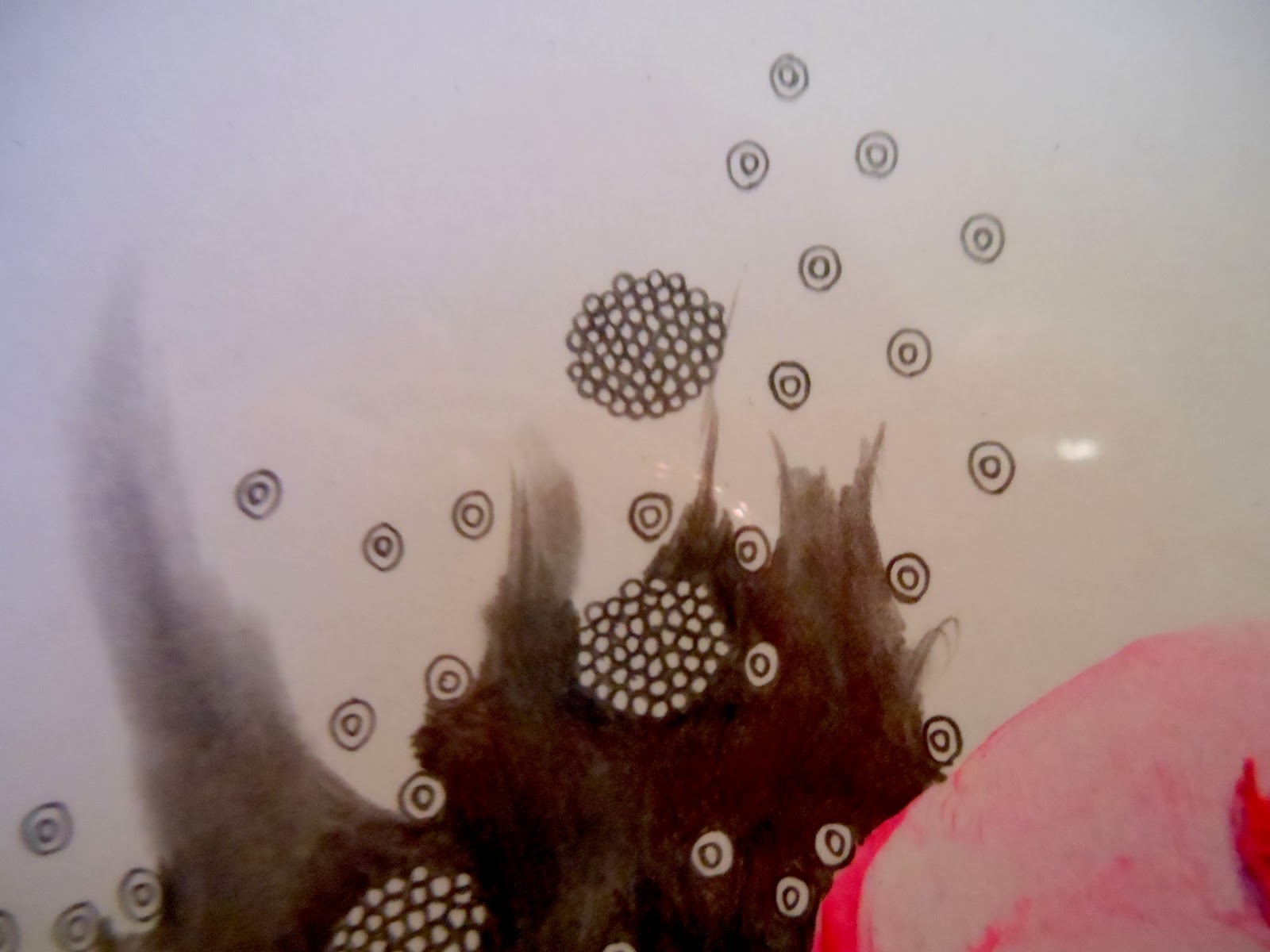
The list of materials on the labels for Saeki's works do not mention "graphite." But that's clearly the material that composes the undulating soft masses—the "clouds"—of gray. The color and sheen, the absorption into the paper, are all characteristic of the material.  Graphite is often delivered to large areas by broad bars or in powder form. Powdered graphite is particularly useful for achieving effects like Saeki's: We see the imprints of the artist's fingertips, which have rubbed accumulations of graphite into the paper both to produce lighter and and darker value, and to thin out its application on sections of the paper.

Hiroe Saeki, Untitled ("Right"), 17.7" x17.7," graphite and acrylic on paper,  2008.
Courtesy of the Pizzuti Collection
What the labels do specify is that the artist used pencil. This tells us that Saeki created these great masses of gray by accumulations of small strokes of graphite, all except a very few of which have been obliterated by rubbing and blending. (One detects discrete pencil strokes along the bottoms of "Right" and "Center,"  They also emerge in energetic tiny shoots from the margins of the gray/white lines in "Left" and "Right."

To think of Saeki's covering pages with tiny pencil strokes will inevitably bring "obsessive-compulsive" to the lips of some for whom such repetitious application is a sure sign of abnormality. But if we attach ourselves in imagination to the hand that holds the pencil, do we really find ourselves acting from a bizarre compulsion? Wouldn't we, rather, be moving with contemplative study and care?

Hiroe Saeki, Untitled ("Left"), 17.7" x17.7," graphite and acrylic on paper,  2008.
Courtesy of the Pizzuti Collection
Floating in some indeterminate spatial relationship to the graphite clouds are tiny circles, sometimes single and sometimes massed like molecules. It's tempting to call these "bubbles" except that they are described by unexpressive line only—unshaded—so that they are distinctly two-dimensional events. Whether they are part of the gray "clouds" or are spatially separate and exist as a scrim before them (if so, by how far?) is uncertain.
white circles/bubbles (author photo)

Were Saeki to have defined the gray areas by the use of graphite by bar or powder with less effort, she would have had to cover too much paper. the coverage of the paper would have been less under he control. It would have been impossible to retain the virgin white areas required for describing those white circles. Each is outlined with fine-point pencil, and the dark background meets its edges precisely. Only by precise application—use of the pointed pencil—would it have been possible to leave the white.

visible pencil strokes at edge (author photo)
The ability of the hand to illuminate the mind cannot be overstated. When my own hand tries to imagine Saeki's, carefully moving across those pages, poised to avoid smudging, sometimes creating density and sometimes the delicacy of "Left's" black-to-white edge, I'm aware how this work would quickly become the sort of meditation that softens one's breathing and cleanses the mind. This work is not obsessive; it's an induced state of being, a reflection that is its own experience independent of the artifact—a completed drawing—that will emerge at some future point.

As the work continues for the artist committed to the calm and patient course, how the stakes go up! When does a plan or goal emerge, as it must? Then, what constitutes error in the composition? Does the plan include the end, or does it remain to be discovered, all of a sudden?
detail from "Left"
author photo
Saeki's pencil draws a medium, environment, or background for events executed in spring-colored twists of acrylic paint. In "Left," the paint is applied as two thick vertical strokes that have the presence of foreground figures. In "Center," an amorphous, filmy creature appears to be suspended in its gray medium. The paint in "Right" is spatially different, caught between planes of the white circles.

The painted passages of the three drawings appear as quickly executed as the graphite appears the opposite. Saeki provides not only contrast, but the drama of extraordinary daring since the paint effaces large areas of the what has been so painstakingly accomplished.

Saeki's willingness to present together the labor in graphite and the intuitive fortunes of paint underscores the depth and seriousness of her work. The wisdom to value without overvaluing the meditative, repetitious movements, combined with the courage to use them as a basis for bold acts of insight—this strikes me as constituting a mature ethic.

Ultimately, I think Saeki's drawings, while touching on questions fascinating to Art—representations of three-dimensional space, techniques in chosen materials, process of composition—are exquisite examples of life and art allied. Whether Saeki's outlook on contemplation and action nurtured her artistic process; or if her thoughtful process has crystallized this connection between constancy and decisiveness I cannot know. But the relationship is indisputably modeled in the work.

Breathtaking work like Saeki's—work that contemplates core issues of how we live—is available to anyone who walks through the open gallery door—and looks.


Friday, November 4, 2011

Is there a Message in this Medium? Consumer Materials in Contemporary Art

The Canzani Center Gallery at the Columbus College of Art and Design (CCAD) is now, as so often, an excellent  place to slow down and enjoy an encounter with cutting-edge contemporary art. "Supply and Demand," the first show from exhibitions director Michael Goodson, is curated by Lisa Dent, CCAD faculty member and associate curator for contemporary art at the Columbus Museum of Art. The exhibit showcases art that uses mass-produced, consumer materials in a significant way. The work was chosen from outstanding local collections.
Alejandro Almanza Pereda, White Carpet Treatment, 2009. 20x36."
Pizzutti Collection. Courtesy of CCAD.  
Alejandro Almanza Pereda's White Carpet Treatment is an exquisite work composed entirely of incandescent light bulbs, porcelain sockets, and electrical wire. It must be an especially intuitive, associative process that brings Almanza to light bulbs ("Eureka!"), for this little "carpet" shows the unusual qualities of mind and eye required by an artist who faces the almost infinite world of commodities, yet isolates the one particular item that serves his ideas. This is quite a different thought process from shopping through the departments of an art store, with its time-honored arrays of pencils, canvas, and clay.


Even in 2009, the world was embracing the CFLs (compact fluorescent lamps). Incandescent bulbs will soon be entirely off store shelves. Almanza's carpet is made, moreover, not of the bulbs one puts in a lamp, but of round, satin-finish ones used in a make-up mirror, or even on a marquee; they radiate the abundance of light that signals old-fashioned movie-star glamour. This photograph of White Carpet Treatment in a dark room—like a marquee against a night sky—reveals a pattern carved out by disabled bulbs, in this case a traditional, double diamond rug pattern. But as installed in the Canzani Center Gallery, it sits on a concrete floor in a brightly-lit room, and it hovers like a shimmering cloud.


The title, White Carpet Treatment, suggests a couple of locutions, "red carpet treatment" and "white glove treatment." The Red Carpet is where the principals of marquee glamour pose in the spotlight, even though they are shadows of real royalty for whom the red carpet was first unfurled. White glove treatment is the painstaking care with which important people are treated. Almanza's VIP carpet, however attractive, is reduced to symbol only, though: it cannot be walked. It is brittle glitter only, barely big enough to stand on. What a brilliant use he's made of lightbulbs—soon to be as outdated as glamour and royalty?


Jim Hodges, Study for a Brighter Light,2002, 32.5x25" framed. Collection of Dave and
Nancy Gill. Courtesy of CCAD.
Study for a Brighter Light, detail
Study for a Brighter Light by Jim Hodges (2002) mounts a "broken" (carefully cut) mirror on paper in a manner that can suggest either that it's exploding, or that its shards are being pulled back to the center for reintegration. Study is a work that almost eludes the viewer, there is so little to it—it has just enough frame to hold it together, and it's hung on a white wall in a room where the mirrors reflect yet more white wall. But this succinct work challenges the viewer to hunt around for something to see. The effort is rewarded over and over. It's actually bursting with subtle events, from the way the paper's matte finish and the texture serve as a black hole behind the mirror's shining reflections; to the sharp sparkle given off by the cut edges of the glass; to the surprising discovery that the "empty," flat paper in the middle can feel like a light source. I don't think, though, that Hodges was inspired by a mass-produced object when he made this. It feels more like the mirror was a collage material that, in combination with paper, could reveal his subject: light.


Jeff Sonhouse, Meeting at the Crossroads, 2003, 65x75." Pizzuti
Collection. Courtesy of CCAD.


Sonhouse, Meeting at the Crossroads, detail.
Similarly, Jeff Sonhouse's colorful, aggressive double portrait, Meeting at the Crossroads (2003), is an exceptional painting enhanced by the use of burnt book matches to represent the Afro-styled hair of the subjects. Sonhouse takes pains to dress his fashion-conscious conjoined twins in luxury pinstriped suiting and silk ties. One twin wears a match-book fox stole. The clothing is all painted with trompe l'oeil finesse. In fact, it took some discipline not to touch the painting to determine whether the suits were made of paint or collaged cloth.


Since the close, painted imitation of reality is one important element of Sonhouse's painting, the use of real products (obvious pretenders to reality) stands in a different relationship to the whole than in a work like Almanza's light-bulb sculpture. Here the mixed-medium is the message, and would seem to support interest in mixed personalities, mixed identities, and mixed social roles. Does an Afro made of matches mean something "real" and incendiary—"in your face?" Does a trompe l'oeil pocket handkerchief suggest the elusive, inscrutable reality to be guessed at?


In her catalogue essay, "Marginal Cost," Dent tells us, "'Supply and Demand' examines the work of artists who...contemplate the necessity of the things we think we cannot live without. As the economic health of modernized nations has become more and more dependent on the production and distribution of commodities, developed countries have found themselves drowning under the weight of consumer goods. Many visual artists have found this situation as an opportunity to consider the consequences of a global economy and the possibilities for creative outlets."


The works I've mentioned don't do that. Two works by Brazilian artist Vik Muniz do. Muniz has gained fame not only for work like the pieces in this show, but for his film, Wasteland, which documents his efforts to improve conditions for trash-pickers in Rio de Janeiro. 
Vik Muniz, Orestes Pursued by the Furies, 2006, 53x40." Collection of
Chuck and Joyce Shenk. Courtesy of CCAD.
Vik Muniz, Medea about to Kill
her Children,
 2006, 50x40." Collection of
Mary Kidder. Courtesy of CCAD.
Orestes, Pursued by the Furies (After Adolphe Willam Bouguereau, a late 19th-century academic painter) and Medea, about to Kill her Children (after Eugene Delacroix) are both from Muniz's 2006 series, "Pictures of Junk." Seen from a distance, each photograph resembles a muted-palette version of a painting with a dramatic classical subject. Upon approach, the viewer discovers that the "painting" in large-format photograph of a scene described in junk, laid out in enormous space on a warehouse floor. Orestes, Medea, and the other figures are outlined in chains, cables and ropes; shadows are made by more or less dense arrays of washers or nuts; and the higher and lower values, the shapes in the background, are formed of rusted paint cans, engines, bottles, tires, barrels, crates, hardware, ladders, furniture, appliances...anything inorganic and mass-produced that can be thrown out by one party and salvaged by another. With this paraphernalia, Muniz undertakes to reproduce canonical paintings of ancient Greek myths that are known to us through the great tragedies of Aeschylus and Euripides. Centuries of highest culture translated and retranslated from one elite medium to another until it's on the concrete, defined by junk. Culture shock, anyone?
Vik Muniz, Medea...Detail, interior of figure showing use of washers.
"Supply and Demand" is a fairly pristine show. The two Muniz pieces excepted, the rest of the work--even the Sonhouse painting--makes sparing use of materials. Even if they were pulled from the trash heap, the elements of each work have been purposefully selected to invoke ideas. Muniz's work is different because he doesn't use trash as metaphor for something else, and he uses lots of it, indiscriminately. In his photographs, the junk is junk, barely sorted.
Vik Muniz background includes typewriter, propeller, muffler.


Neither Orestes, Pursued by the Furies nor Medea, about to Kill Her Children protests the heaps of junk, however. Where Muniz the man is apparently involved in social action to improve the lives of people who have to survive off trash; and though he does this by making art works like these and selling them, it doesn't add up that the artworks themselves protest the existence of the junk or constitute activism. The piquant point in this work is the contrast between trash and cultural treasure. Depending on where one stands, either junk or the art canon may be deplored; either may be valued. But about recycling, or the excess of abandoned consumer goods, I think there is no political statement in the works themselves.


U.S. first class postage stamps, 2011
Recycling, consumerism, and over-population are pressing social issues, so it's reasonable that they would interest contemporary artists. It's incorrect to assume, however, that discarded and repurposed commodities are the subjects of art they appear in. For many middle-class Americans in the early 21st century, junk of the sort Muniz depicts induces  mixed feelings. There's the guilt and anxiety we feel about our roles in a wealthy and wasteful society. But guilt conflicts with aesthetic tastes formed by the culture's elevation of what is by now called simply Design. We never imagine well-designed goods as part of the junk stream, no matter how many broken plastic Eames chairs or shapely Crate and Barrel Plexiglas canisters are thrown out. We make socio-economic and aesthetic assumptions when we think about trash.


For others, on the other hand, consumerism's cast-offs represent abundance and play. Tinkerers, flea market optimists, antiquers and collectors will take the risks of finding golden needles in the flotsam and jetsam. They believe not in recycling, but in alchemy.


Jean Tinguely, Heureka, at Zurichhorn. Photo by Roland zh.;
licensed under Creative Commons.
The Dadaists exuberantly appropriated anything they could reimagine. The Swiss sculptor, Jean Tinguely (1925-1991) made kinetic sculpture from his enormous collections of industrial parts and equipment. He was a satirist of mass production in fact, but his work is now beloved more for its antic whimsy than for its sly commentary. It's comparable to movie maker Jacques Tati's anti-industrial irony in the figure of M. Hulot. Hulot's humanity is radiant in any generation and circumstance.
Simon Rodia, Nuestro Pueblo, detail,
Photo by Polylerus; licensed under Creative
Commons.


Along the same lines, outsiders and artists working in folk traditions have always re-purposed consumer goods as art materials. Simon Rodia's Watts Towers (Nuestro Pueblo) are built from found objects secured to armatures of pipes and mortar. They incorporate cast-offs from a pottery factory, bed frames, and soda bottles. Rodia scrounged materials himself; his project attracted found contributions from many interested people.


Bill Miller, JFK Freak Flag,14x20." Courtesy of
the Lindsay Gallery
Contemporary artist Bill Miller works with folk motifs but isn't motivated by necessity to salvage linoleum from buildings facing the wrecking ball. In JFK Freak Flag, old linoleum patterns put images of the 1960s into a context of folkloric "bygone days." Space travel, the Peace Movement, and iconic images of the Viet Nam war are mythologized—both augmented and de-clawed at the same time. The linoleum lends the feel of the '30s or '40s. That aura of a time even farther away, a period of greater simplicity, adds to the poignancy of Miller's work.


Especially in the Third World, discarded consumer goods are recycled into striking, useful items by crafts workers who profit by their sales. These photographs show how of newspapers that are rolled and used to make mats. The coin purse is made of woven candy wrappers. But these charming works, unlike those sponsored by Vik Muniz, fetch $5, not tens of thousands. Why? They are consumer commodities, not art, that singular commodity that few can afford.


When it comes down to activism—doing something about the proliferation of trash—workshop artisans have it over the artists: They are consistently and systematically doing something to reduce the junk heap. They're trying to earn a living, but their occupation is all about the materials. 


Obsolescence; death; waste; greed; abundance; material display: These are all themes for art. Many materials can be used to express them. The connection between materials used and ideas arising from a finished work of art is a result of the artist's skill. It's unlikely that reassigned materials will tell the story by themselves.


"Supply and Demand" is a terrific show. Dent's catalogue is printed as a glossy pamphlet the right size to carry and read—or to ignore—while viewing the show. Refreshingly, there is not a single label in the gallery. Whenever you're ready for discussion, you have a booklet with the thoughts of a deeply informed person who's been reflecting on contemporary art for her whole career: the ideal interlocutor. My disagreements with Dent on some points are a sign of the show's strength and ability to engage. She gives us great work and pitches guiding ideas. The table's set for a smorgasbord; let the viewer step up.