Showing posts with label African art. Show all posts

Sunday, February 2, 2014

Wood Sculptures at a Senegalese Market: Art, Value, and the Tourist's Eye


On a recent trip to Dakar, Senegal, I visited the artisanal market at Pointe des Almadies, where authentic regional art and crafts are to be had. 


Not that these cannot be found in shops (i.e., the kind with lighting, doors that lock at night, and discreet sales ladies). But in shops, arts and crafts items are carefully vetted, and they are marked up to high, commercial prices. Foreigners with experience or coaching know that similar or identical items can be found in local markets. 

But to visit the marketplace (open stalls, no amenities, proprietors who are hell-bent on sales) if you are to enjoy the advantage of better prices. You must be prepared to stand up against those badgering, aggressive vendors. You have to be willing to bargain staunchly for that better price. You should assume automatically that any item is worth half or less than  the stall-keeper's asking price. Even the price asked, however, is probably a quarter of what would be asked in the swell boutique with doors. 


In the stalls at the artisanal market, one can find many beautiful and fascinating things: djembes and talking drums; jewelry made of seeds, shells, beach glass, ceramic beads, wax cloth; paintings of village scenes; leather sandals and bags; and, above all, carved wooden items from tiny trinkets to large, free-standing sculpture.

Most of the stalls offered small carved wood objects, whatever the real focus of its inventory was. Everyone had small, rough-hewn wooden turtles: Even at "full price" they'd cost very little. Their ubiquitousness suggested that they, like a few other items, may have been made entirely as tourist trinkets. 

I discovered once I got home that several rare kinds of turtles (marine and desert) live in Senegal, and that there are companies that even take tourists out to watch loggerhead turtles lay eggs in the sand. Turtles are likely to mean more even than tourist dollars to the Senegalese. Where was the line between made-for-tourists, and shared culture?

In the shop that carried wooden sculpture exclusively, the proprietor spoke pretty good English and was willing to spend some time actually discussing his merchandise with me. He did in fact have some stunning sculptures, like a sinuous, gleaming alligator carved of ebony that hung on the wall, five feet long in its curled state. No one would consider it other than a work of art, so well made, so well designed, so spirited a piece it was. Clearly it was made by an artist—whoever that person is, living under whatever circumstances, with who knows what expectations for the sale of his/her work. The alligator was what a small museum would be happy to collect for its African Art wing. It was a carving that was wonderful on aesthetic grounds alone. Its local significance could be made as relevant or irrelevant as curators and viewers wished.

Alike but different; faces or masks?
On the other hand, there were a great many modest objects that fell into a zone between the crude turtles and the magnificent alligator—for example, carved faces that were, as far as I could tell, masks of some sort. That they were incomprehensible to me was a block to my appreciation on even a basic aesthetic level. Were they the result of any particular local need or impulse? Or were these tourist bait, designed to look like Western ideas of African carvings? 

Here I was in an artisanal market, but I was confused by a blurring of several values. What was I looking for? Authenticity in terms of tradition, culture, or use: Yes. Aesthetic appeal and craftsmanship: Of course. Yet wasn't I quick to judge anything for appearing in a stall that I thought "too touristy? Wasn't I hasty to dismiss items I considered (for arbitrary reasons) kitsch, despite their being local and hand-made? How could I know the intrinsic value of anything there, knowing nothing of its significance?

Friday, Saturday, Sunday
If it hadn't been for the obliging shopkeeper whose English was a little better than my French, I think I'd have made no purchase. I think that these seven little teak carvings opposite would have remained impenetrable to me. I'd probably have examined them one by one, tried to decide which I liked best, and decided that none was all that compelling.

The shopkeeper brought all of them down at once, then he laid them out side by side, arranging and rearranging them carefully as if he were beginning a game of solitaire. They were not individuals, but a set of seven carvings.

They are, he explained, a calendar for the illiterate of their Muslim country, each indicating one of the seven days of the week. Each day, the appropriate carving is placed vertically to insure that the household proceeds in orderly step within the community.

In the photograph above, the carvings are laid out in order, beginning with Monday. Monday has one point at the top of the head. Tuesday has two. Wednesday's more elaborate, dual pairing (two straight up, the middle two coming together) indicates the day of the week traditional for marrying. 

Thursday has four points and a clipped beard as well. The four points are not only for the fourth day, but together with the trimmed beard indicate the day for the barber, where one is neatened up for Friday—the day a man wears a hat and combs his beard to go to the mosque.

Saturday and Sunday are days to be lazy about personal appearance. The points on top are "disheveled" and by Sunday the man is wearing leisure clothes and ornaments that are represented by the folds and forms surrounding the face.

I am very happy that I bought the calendar (in teak; a similar calendar in ebony was more than I wanted to pay). I am fascinated that it is so full of ideas and that looking at it takes me to a world I wouldn't have imagined without it. It's already served what I consider one of the functions of art just by opening a door that takes me past the thing itself.

Now that I know its significance, it is more appealing to my eye than it was before. The fact that it is not finely wrought makes sense and completes its story in a satisfying way. Was it made to be used? Or was it made to sell to tourists? Should I know? Should I care? Would knowing increase or decrease its authenticity and appeal for me?

I had been given the figure on the right as a gift in
the past. Now I know it to be a Sunday
figure from an ebony calendar set.
When I visit collections of African art, I'm always amazed by the forms, colors, and ideas of representation or symbol so different from those I'm familiar with. In museums, African art is often staged in a position closely bordering on anthropology, and the work of a vast continent with myriad cultures is of necessity, though unhappily, all clumped together. 

At the artisanal market, though, I felt that I gained some minor insight into the process of collecting artifacts from a far-away culture. What is art, what is tool, and are such distinctions useful? If it's made for trade, is it less valuable? If it's common, is it less valuable, or if it's rough rather than perfected? None of the distinctions I'm used to working with—even if only to challenge—made any sense in that Senegalese market. It's a place that either requires a set of questions I haven't discovered yet, or one that I haven't learned to put away.


Friday, August 30, 2013

Arabic Calligraphy in West Africa: Yelimane Fall at the Krannert Art Museum

I found these eye-popping canvas hangings in the permanent collection of the Krannert Art Museum at the University of Illinois at Urbana-Champaign. In Senegal, a small country, the farthest west in Africa, many roads have crossed throughout history. Slaves were traded between Africa and the West from Dakar's Goree Island. And here, too, local religions were penetrated by Islam in the mystical form of Sufism, little known elsewhere in Black Africa.
Yelimane Fall, Seven Lines from Jawartu, 2003-2004. Acrylic on canvas.
Krannert Art Museum and Kinkead Pavilion, University of Illinois at Urbana-Champaign 
Art Acquisition Fund 2007-16-1.2/1.3/1.5/1.6
Surat al-Fatiha. Islamicartdb.com
These paintings are the work of Yelimane Fall, an eminent Senegalese calligrapher and follower of Cheik Amadou Bamba, a saint of Senegalese Islam and a secular hero who led non-violent resistance to French rule in the early twentieth century. The work is surprising on several levels. Certainly the first is its contemporary interpretation of Arabic calligraphy. In Beauty and Belief,  the outstanding survey of Islamic art that I reviewed in January '13, the many examples of Arabic calligraphy demonstrated the values of exquisite control over ethereal forms. The tradition is virtually angelic in its lightness, intricacy, and restraint. The look of Fall's work is far from those traditions in the boldness of its forms and colors, the lack of framing around the designs, and the relentlessness of its determination to catch your eye and hold it. They are the opposite of evil-eye protection; they stare you down.
Courtesy graffitimuseum.com

In fact, these hangings are so brave and contemporary in color, complex in composition and letter-form, that they seem more related to graffiti and tagging than to traditional Arabic calligraphy. While the artist doesn't mention such urban associations, in excerpts from recorded interviews from a residency at University of Illinois, Fall speaks directly to the great difference in aesthetics. The Arabic tradition is indeed about the beauty of the letters, which the calligrapher transforms, raising them up. But he is a Black African, and Arabic is not the language of his country or region. He does not understand his mission to lie in transforming the letters. In another film elsewhere online, he reminds his Senegalese interviewers that his language is Wolof, a tribal language spoken around Dakar and St. Louis, in the north of the country: Arabic is a foreign language to most Senegalese, and has very specific, religious use only. 

Fall, thus, is concerned that his viewers "feel, read, understand, think" in local terms. Though he uses the sacred language of the Koran, his calligraphy is thick, colorful, and made to look slower-paced than calligraphy in traditional styles: "Everything moves back to Earth. Even when my work flies, I bring it back to Earth." In this he sees himself work in what he feels is an African mode. His color, forms, and speed are native and significant to those who view it, who connect with the sacredness of texts meaningful but not necessarily legible.
Yelimane Fall,Seven Lines from Jawartu, 2003-2004.
Acrylic on canvas.Krannert Art Museum and Kinkead 
Pavilion, University of Illinois at Urbana-Champaign 
Art Acquisition Fund 2007-16-1.2/1.3/1.5/1.6

The series of four on display at the Krannert Art Museum are not Koranic texts, but refer to Jawartou  a twenty-nine line poem written by Cheik Amadou Bamba.


The translation provided for the first panel, shown at the left, is: "May I only know the joys given by the Sublime One Who Offers Benedictions, until my entry to Paradise."

This, like the others in the series, looks to me like a fabulous puzzle, or even like magically colored marquetry, so precisely formed and laid down are the strings of writing within the large shapes of black and blue. Fall calls his wooden writing instrument a kalam, which allows precise shaping.

Without great knowledge of Islam, I am still excited about the many levels of activity in this painting. While there are neither shading nor any apparent color placements that would create volume, I nevertheless feel that something is constantly moving in or out of my peripheral vision. The combination of small forms among the big ones; the curls that end in circles, and the fluidity of those long lines of script keep the surface in constant flow. There is no background; it feels like the foreground constantly recreates itself. 
Yelimane Fall, Seven Lines from Jawartu, 
2003-2004. Acrylic on canvas.
Krannert Art Museum and Kinkead Pavilion, 
University of Illinois at Urbana-Champaign 

Art Acquisition Fund 2007-16-1.2/1.3/1.5/1.6

"Through love and the words 'there is no God but God,' may He hide my well-guarded secrets." This second hanging is quite different in look, appearing as forms laid out on a yellow surface with very little overlap. The illusion of depth or movement isn't great, but the sinuous sensuousness of separated shapes provide a tense excitement in themselves. 

Central in the composition is a large, blue numeral 7 (we remember that our numbers are from the Arabic writing system). Glancing back, and at all the paintings, 7s abound. The title of the four-part work is Seven Lines...

In the taped interview that accompanies this exhibit, Fall informs the viewer that the number 7 has important mystic meaning. It represents the double function of the key, which both closes and opens. The Koran opens with seven verses, the Fatiah, but, he says, "wherever you go in Muslim mysticism, 7 guides you." 

The spirituality of his work derives from Fall's allegiance to Bamba, founder of the Brotherhood of Mourides who, even more than other Sufis, attempt to live close to God. Bamba claimed to have met Muhammed in a dream, and Fall recounts having met Bamba in a dream as well. The mystical content of his work, then, is very convinced and follows deep rivers of religious tradition.


Yelimane Fall,Seven Lines from Jawartu, 2003-2004
Acrylic on canvas
Krannert Art Museum and Kinkead Pavilion, 
University of Illinois at Urbana-Champaign 
Art Acquisition Fund 2007-16-1.2/1.3/1.5/1.6
Of the twenty-eight Arabic characters, fourteen are of light and fourteen are dark, Fall explains in his interview. The first seven are fire; the second seven are water. The seven following are air, and the last are earth. The colors, too, have assigned significance. Red, for instance, is fire; black stands for earth; air is white and water is green. The language, then, is not merely one of letters, but of colors, and a world of esoteric meanings non-believers would not dream of connecting to other than aesthetically. 
 fall in what order, or if he has colored the fire letter red or green. This leaf is translated as: "Through His grace for my profession of faith, may God keep me from all slander." 

I tend to follow art to conclusions that may end being either surprising or intuitive. In general, I trust that if the work moves me, the artist has invested what is most important into making it excellent. I think of art inspired by any faith as having a reverential aspect, a controlled fervor that reaches for the ineffable through symbols. 


Courtesy graffitimuseum.com
Islamic art uses text literally and symbolically at the same time. The word is treated literally, as the vessel for expression and feeling. In Fall's series of paintings I see both faithfulness to that tradition and ecstatic departure that asserts everything earthy and African, brilliantly contemporary and urban.


Monday, October 8, 2012

El Anatsui's "Gravity and Grace" at the Akron Art Museum

El Anatsui, Red Block, 2010. Aluminum and copper wire. Two pieces, each
measuring 200.75  x 131.5." Author photo.
The tour de force show, Gravity and Grace: Monumental Works by El Anatusui, recently closed at the Akron Art Museum, where it had been on display since June. The show travels to the Brooklyn Museum, to open in February 2013. It is infinitely to Akron's credit that they brought this work by the great African artist to the United States and organized the tour in conjunction with Anatsui's New York gallery, Jack Shainman. Akron was the first American museum with the foresight to collect El Anatsui even before he was included among the African artists in the 1990 Venice Biennale, where simultaneously he was discovered and received as a master by the rest of the world.
El Anatsui, Earth's Skin, 2009. Aluminum and copper wire. 177x 394." variable.
Courtesy of the artists and Jack Shainman Gallery, New York. Photo by Joe Levack, courtesy of the Akron Art Museum.
Anatsui was born in Ghana but works in Nigeria, where he keeps a large studio of assistants busy fabricating his monumental works. These are constructed only of liquor caps and copper wire. The works made from these materials began with the serendipitous discovery one day of a sack filled with liquor caps, which he took back to play with in the studio. He now acquires them not by scavenging, but through industrial recycling in partnership with a distillery.


While one can compare Anatsui's metallic draperies to any number of African, Eastern, an Western art forms and materials, they remain unique: astonishing in beauty and bountiful in metaphorical connections. The artist's statements for the the Museum focus on the poignant power of the caps as symbols: Liquor and slaves once were both commercial products exchanged on West African shores. This token of commercial ties between the Americas and Africa is likely to felt as a natural poetry to an African—as deep and simple as the blues—even if North Americans have to process the thought as history and to consult the footnotes for nuance.


 What I find almost heart-stopping about the walls draped with monumental sheets of tiny, linked metal is neither the far that they are created from humble,post-consumer materials, nor that a sobering historical link between peoples and centuries is made in the process of typing together these symbols of dehumanized souls. Both of these points—central aspects of the work—come as afterthoughts to my direct, sensory experience of monumental, glimmering, luxe hanging artworks. Anatsui discusses these in relation to painting, but I find this comparison puzzling and remote.

Anatsui produces this work in flat sheets that are constructed gradually as small units are attached to one another to create ever-larger ones. The completed work is essentially a flexible, two-dimensional sheet with shape defined by its edges, but which has no internal rigidity, like fabric. Since Amemo is not even four-square, it can appear unique with each differently oriented installation, its colors concentrated in ways that create a new work from the same cloth each time.
El Anatsui, Amemo,(Mask of Humankind), 2010. Aluminum and copper wire.
208-5/8 x 161-3/8." Courtesy of the artist and Jack Shainman Gallery, New York.
Photo by Andrew MaAllister, courtesy of Akron Art Museum.


Oni of Ife, Nigeria
Queen Elizabeth II of Great Britain in
coronation robes
Especially since the works are shaped as the installers (performers? tailors? costumers?) hang or dress them, I think it's useful to understand the works are textiles into which rich designs are knitted. They are tapestries, royal robes, even decorated chain mail armor for princes and heroes. Images of robed royalty from several cultures reside comfortably in imagined proximity to Anatsui's metal tapestries. There is a mutual reflection of majesty.


Bouba Abdoulay, Sultan of Rey-Bouba,
Cameroon
18th c. Hawaiian royal cloak
Ancient Japanese armor
Skilled knitters, embroiderers, lace-makers, and weavers employ traditional common languages of stitches. The fineness, inventiveness, and value of their work are measured by their skills with their particular stitches and control over the spaces between them. Sometimes their work is dense; sometimes light and airy; and sometimes the effect depends on the a combination arising from the artist's decisions about how much tension to keep on the thread, how much to twist it, and how to anticipate the final effect as the work is in process.


Basic construction stitch of Gli
Anatsui has similarly developed a vocabulary of folded shapes for the bottle caps. His studio workers spend days simply creating deep caches of each type to serve as the basic "stitches" for the work. They assemble units of these with copper wire, and then make increasingly large units in designs the artist designates. It's comparable to patchwork quilting, an additive process of design.
Construction using both positive and negative
space.

While the viewer's impulse is to marvel at all the caps used in the work, it's also important to notice how Anatsui uses space in the pieces too. Some of the work is as dense as armor and other—the Gli, or Wall, especially—is diaphanous, even though all is assembled from the same material.


Shimmering, transparent Gli
El Anatsui, Gli installed. Author photo.
In Akron, each section of Gli was hung simply, without bunching, like a scrim on a theater set. It's easier to see through these floating walls from a distance than close up, when the eye wants to focus on details of bottle caps that stand out from the fabric's basic, repeated stitch. As I looked through one from a distance, though, toward a massive piece hanging on a the gallery wall, Gli seemed to provide a textured, golden glow that heightened the sensual appeal of the view, making it even more pleasurable to be standing just where I was, satisfied.


In the video on the Akron Art Museum's page about Gravity and Grace, Anatsui notes that the concept of a wall is a human construct; that walls sequester, divide, and deprive people of freedom. As with his comments on the sock-political meaning of liquor bottle caps, I appreciate that this is a meaningful starting point for a conception of walls. But again, I perceive that these particular walls that he has made appear far away in their effect from the metaphors he cites. Because the walls that shimmer in this gallery are so light, penetrable, and radiant, I find thoughts of restriction or prevention the farthest ones from my mind as I view them. These walls dissolve more than they divide.


El Anatsui, Waste Paper Bags, 2004-2010. Aluminum printing
plates, paint, and copper wire. Variable sizes up to 86" high,
between 36" and 54" at base. Author photo.
Gravity and Grace includes earlier bodies of work as well, notable the Waste Paper Bags made between 2004 and 2010 from recycled aluminum printing plates. These are free-standing sculptures of monumental size, assembled from mashed but legible printing plates held together by copper wire. While recognizable in the form of carrying satchels, they have the presence of human figures. To move among them is to await your bus with anxiety in the giants' terminal The induced grief and weariness in me. To look at them is to look into a trash heap of discarded, half-burned, defaced human stories. 


Detail, Waste Paper Bags.
In these carry-alls, people carry around lives of trash. How can one feel beauty or value in a world where ugliness and waste prevail? I think the Waste Paper Bags achieve more eloquently the purported social goals of the work in bottle caps. Messages about the ubiquitousness of trash, of consumerism's ravishment of the environment, of the destructiveness of Western capitalism on rural Africa—these and other issues born of the tensions between Africa and the West appear built into the fabric and final expression of this series.


Last year I reviewed a show of truly surpassing beauty, art of the ancient Ife culture in what is present day Nigeria. Nigeria is the home of some of the most awe-inspiring and spiritual art in the world, the products of brilliant civilizations known mostly to archaeology now. As in many former Western colonies (slave ports before that), cultural identity has to be an extremely embattled question not only in the collective, but in any individual artist's soul. To have such noble local heritage, yet in the present day to live in a country so wounded by its contact with the West—this is a situation we in the United States can try only with the greatest exertions of imagination and humanity to fathom.

El Anatsui, Gravity and Grace, 2010. Aluminum and copper wire. 208-5/8 x 161-3/8." Courtesy of the artist and
Jack Shainman Gallery. New York. Photo by Andrew McAllister, courtesy of Akron Art Museum.
El Anatsui's work in Gravity and Grace addresses in just these modes the appalling divisions that must exist between his part of the world and ours. He demonstrates monumental cultural decisions to be made when reality constitutes a modern inheritance of trash and memories of ancient splendor. Gravity and grace are what he presents in this tremendous show, through a sober, dignified, and luminously humanistic mind, rooted and raised in a very specific soil.
El Anatsui, installation at Akron Art Museum. Aluminum and copper wire.
Author photo.

Tuesday, May 22, 2012

Twentieth Century Reality Show: African Art at Indianapolis

What amazed me the most in my heady tour of the newly redesigned African galleries at the Indianapolis Museum of Art—and there is so much competition in the astonishment department!—is that so much of the collection dates from the twentieth century. 

"But wait!" I think. Artifacts from far away; things that look so strange (read: "primitive") must be old. They are centuries, eons away from our world view. Aren't we used to visiting museums to find the past preserved?
View of The Eiteljorg Suite of African and Oceanic Art. Courtesy of the Indianapolis Museum of Art
The core of the outstanding Indianapolis collection was the 1989 gift of Indiana businessman Harrison Eiteljorg (1903-1997). He and his wife donated over 1,200 works to the IMA. The museum has built further on the Eiteljorg collection with acquisitions and gifts that make it now one of the nation's premier sites for African art, with outstanding pieces representing all areas of the continent. It's also large enough that it's able to be presented thematically, emphasizing such topics as body adornment, relationships to ancestors, power, and royal arts.
I explored with the simplest questions in mind: "What is this thing? What's it for?"  For I find it staggering that nearly all the intricate, highly decorated, beautifully crafted things in the collection are three-dimensional pieces of functional art.  Almost nothing in the gallery, however imaginative or formally ingenious, fails to serve a purpose. However astonished I found myself, however gratified my imagination, everything was still firmly planted in modern or contemporary reality. This headpiece in the form of a crocodile was used by Niger River Delta men's associations in their practices because predatory animals are considered guardian spirits. 


I loved these two realistic, female forms with their empty, outstretched hands, the one standing, the other kneeling on a base with a fish, as if by a riverside awkwardly depicted by a carver. Too beautifully modeled to be beggars, perhaps they were religious suppliants, I wondered? Quite the opposite, the notes informed me: They are deities. For some people, it is quite natural that they look exactly like human women. The standing figure apparently would be kept in a shrine. Her image is thought to protect and heal those who make sacrifices to her. The kneeling water deity expects to have her hands filled with offerings.


In the 20th century African exhibit, the lines we in the West draw so sharply between human, animal, and spirit are broken at best. But I found myself thinking after a while that they weren't perhaps so strange to anyone who has read books to children who are learning about the forces of the world, in nature and in themselves. 


This extraordinary head crest made by the Efik people of Nigeria left me completely agape with its weirdness and beauty. The tough extravagance of the hide-wrapped horns that grow from this small head exquisitely inlaid with marquetry designs makes it hard to believe one's eyes. A label suggests that this represents a "spiraling hairstyle." My own reaction though, made me laugh remembering David Small's book that my children and I loved, Imogene's Antlers. It's the story of a girl who wakes up one morning to find that she's sprouted an antler rack of stunning size, and that it's real. She takes it in stride, leaving those around her to find ways to cope. In the Museum, we can elect to be either Imogene or her fainting mother, appalled by the very sight.


A men's association from Cameroon used the guise of an elephant when they worked under royal blessing to keep the peace. Despite the enormous pendulous trunk, this pachyderm mask nevertheless sports a human nose, suggesting to me a genial and perhaps unconscious blending of the gifts of wisdom and succor found in both species. Atop a Yoruba royal head in Nigeria, little white-eyed, birds rest among big, red, beaded berries, demonstrating regal pomp in a manner unusual to eyes accustomed to diamonds set for their own sake.
Yoruba crowns


A Yoruba men's society fashioned a phenomenal headdress in the early 20th century, the Magbo Society Mask. The Magbo Society enforces community penalties but also insures burial for every member of the society, regardless of rank or wealth. The mask, therefore, is decorated with thirteen figures that represent the many kinds of people that constitute the community: a soldier, a farmer, musician, and nursing mother among them.


Hinge-jawed masks from the Ogoni people of Nigeria are character studies that focus on unique features and attitudes. A cap mask from Cameroon, made of wood, pigment, shells, hair and various fibers, has no realistic features, but to the people who made it, it clearly represents a king: Note the beard and the extravagant use of prized cowrie shells.


One of Harrison Eiteljorg's most beloved objects was a mask from the We people of the Ivory Coast, composed of wood and cloth, nails, shells, used cartridges, leopard teeth, porcupine quills, fur, pigment, and on and on. Were it not in a case but still in the world, each generation would add yet more to it, for the idea is that such a mask enters the world as a piece of wood that accretes offerings forever, gaining potency with each generation's enhancements. The idea is that it embodies forest spirits that become accessible through dreams. It could have been a model for Maurice Sendak's wild things, a sort of benign, protective terror. 


For me, the Eiteljorg African galleries are a wonderland where the real world of a century we've just left is treated with joy and reverence; where nature and humankind are presented in myriad ways, each one observant, penetrating, and packed with meaning. The abundance of points of view, the multitude of solutions to the same practical and design problems (how to make a pipe; how to indicate the presence of royalty) fill me with the delight of pure abundance. 


man's hat, Pokot people, Kenya
I live in an efficient world, thrifty of its media, thrifty in its aesthetics. Culturally, we agree on little, so symbolism isn't a normal or potent mode for much communication. The use of disguises and personae are either illegal or appear silly. We are literal-minded enough to think that one must live either with theology or atheism. We do not see the world as a dynamic, nuanced, wondrous place that is our habitat, rather than our dominion.


The innumerable worlds of Africa merely hinted at within these rooms in Indianapolis make this viewer long not only for modern Africa, but for the the world I never notice around me for lack attention and imagination—how it sifts and drifts around me, perhaps changing form and color, animated with wonder back behind the squawk of the alarm clock and the aggravating sequence of traffic lights.


kind feminine spirits


Photographs by the author of materials on display in the Eiteljorg Galleries of the Indianapolis Museum of Art.

Thursday, December 22, 2011

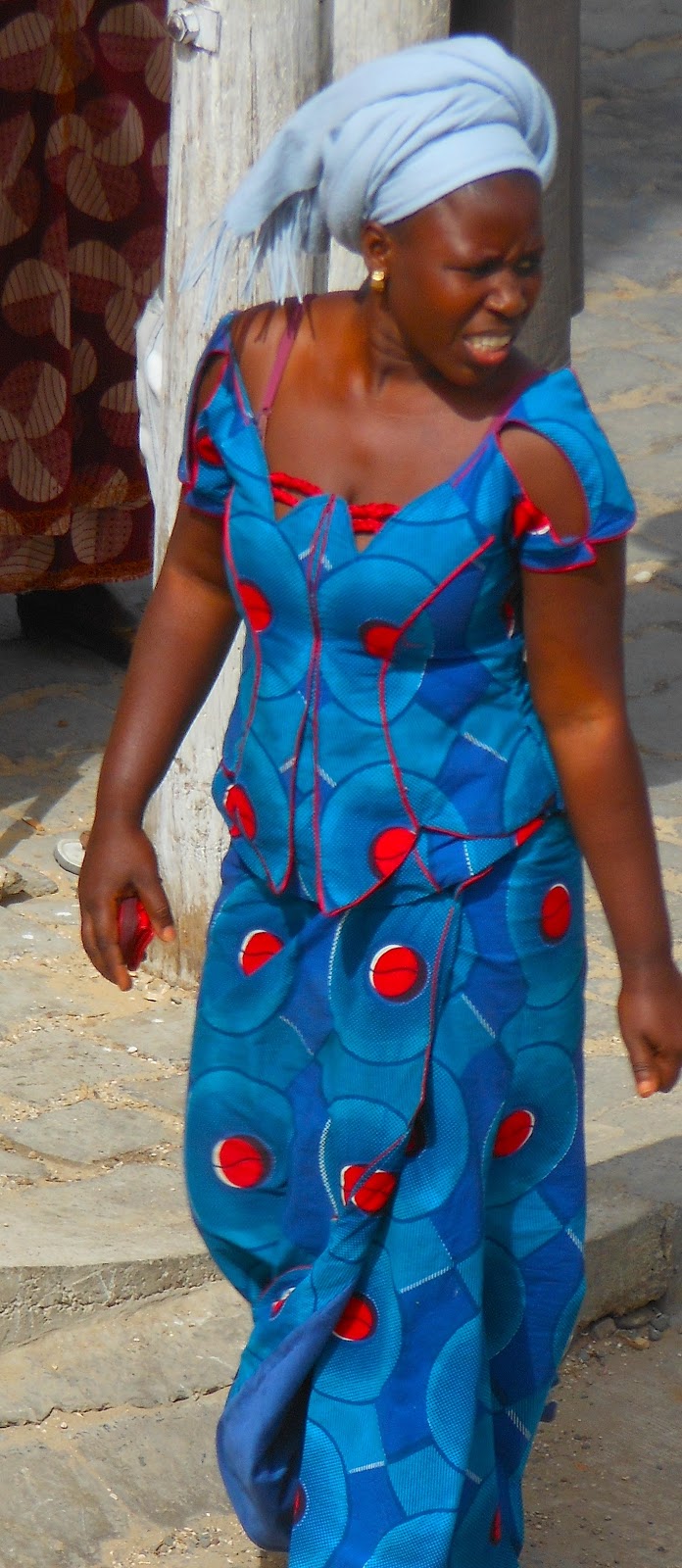
Wax Cloth and Textile Designs on the Street in St. Louis, Senegal


 On a recent visit to the northernmost city of Senegal, St. Louis--located near the border of Mauritania, where the Senegal River meets the North Atlantic--I had a few hours to watch people come and go downtown. The Senegalese are touchy about being photographed, so I've found it frustrating in my travels there to get photos of the vivid daily dress that I so admire. My hostess assured me though, that from our balcony, snapping photos in the interests of fashion would be fine, so I invoked the spirit of Bill Cunningham in the interest of art journalism.

My hostess in St. Louis is my new Congolese sister-in-law, a woman whose wardrobe exhibits her impeccable taste and insistence on first-quality materials. She is the mother of five daughters (the youngest is twenty), all of whom are tres chic. One hosts and produces a twice-weekly television program in Dakar on subjects that include current fashion.

In this family, the women move naturally between traditional dress and contemporary Western dress. The sisters tell me that they tend to save African garments for formal occasions. During the two weeks we were together, though, they did indeed enjoy the comfort of casual, capacious African garments.

Madame wears nothing Western. The difference between her day-to-day attire and her ensemble for the wedding of our children left no question, though, about which was which. The difference was materials, the latter being made of fabric shot through with gold thread and her headdress of lavish design being yet more radiantly golden. Day to day, she is usually in wax.

Wax cloth is decorated with wax resist processes, the best known techniques in the West being batik and tie-dye. Both  are ubiquitous, and, like nearly all fabrics I've seen in Senegal, they are brightly colored.

Few of the fabrics worn in Senegal originate there. Some are made England and the Netherlands exclusively for the African market. But many come from Mali, Nigeria and Cameroon; all carry the mark of their nation of manufacture. Quality varies: Some bleed and shrink when laundered; the best are very stable.

The batik and tie-dye processes help trace the origins of wax cloth back to Indonesia, which was a Dutch colony in the 18th century. Through Dutch trade and manufacture, the fabric and processes were imported to Africa.

The other highly popular form of wax is printed (machine or block-printed) resist designs, from simple to elaborate. These are, again, nearly always bold and bright, in colors of great intensity. Some of these designs clearly require five or six printings, their designs have so many layers of interlocked designs.


The pictures below are selections from my pleasant morning of fashion-watching above a busy commercial corner in St. Louis, on a 85º morning in December. From time to time a car rapide, the cheapest form of local and inter-city transportation will drive through, each with its own painting and personality, reflecting the exuberant approach to color and decoration that mark life in West Africa.