Showing posts with label Hammond Harkins Galleries. Show all posts

Sunday, July 12, 2015

Linda Gall's "Old Wood & Ancient Haunts"

Linda Gall, Loose Wires, watercolor, 6 x 9," 2014. Courtesy
of Hammond Harkins Gallery
Linda Gall's watercolors showing at the Hammond Harkin Gallery in Bexley, Ohio can be described only by their own, eccentric presences. Old Wood & Ancient Haunts? I accede to her title because the show is decidedly narrative and so it deserves to be called something. But the narrative is up to you, the viewer. There's a lot of time-worn wood featured in it. Ancient haunts? Does that mean the sagging old farm and ranch buildings? I suppose it that's one way to look at it. But there is room to see a multitude of haunts in this work that seduces not only by its beauty, but by its vivid peculiarity.

"Loose Wires" is the simplest piece in this show, but it contains the essence of the fascination her work holds for me. The wires are loose, but they are not disconnected. It appears that the stakes are loose and it is the wires that hold them together. The posts are firmly planted and the pieces of what are probably broken wood between hang loose. (They remind me of clothes pins.) They dangle before/above/beneath…what? In this painting made from observation, there is no setting, no context. Gall shows us what, but "where" is defined only by the blank page. Out of this, she nonetheless convinces of contrasting stability of posts and instability of the web between—as if this were in the Real World. Could be. Maybe not.

As a watercolorist, Gall is self-taught. Perhaps this explains why her command of the medium is so thrilling: Nothing holds her back. Her range is considerable: The colors are a mix of brilliant and saturated with dull; her edges run the gamut from sharpest to wet and dissolving. An exciting  "painting without a net" quality brings every work alive—or, it allows the life of the work to seize you. These truly freehand paintings are done without any pencil plotting or guidelines. The daring delivery of paint adds to the thrill of her odd and ambiguous subjects.

Linda Gall, Troubadours, Watercolor, 17 x 36," 2014. Courtesy of Hammond Harkins Gallery.


Troubadours, above, is quintessential Gall. On an unpainted (empty?) sheet of paper, a utilitarian farm structure in disrepair sits athwart us and a Rococo figurine of a boy and a woman with a guitar faces us directly. The originals for the structures in Gall's work inhabit the landscape around her New Mexico home. They have been observed and we assume that the likenesses are genuine. 

Linda Gall, Annie O. Acrylic on panel, 20" x 24." 2014? Image courtesy
of Hammond Harkins Gallery
As here, Gall has populated many series of work over the years with selections from a wide assortment of china figurines. As a toddler will use any figure at hand, regardless of its look, to represent a character in his or her play fantasy, so these figurines seem to function for Gall. They hold places for imaginations; they represent whomever we want them to be, from whatever period and place we wish. They will stimulate viewers to their own story-making within the setting the painter has begun to make. 

In another essay about this show, I noticed that these represented china pieces were called "tiny figurines," as if they are equivalent to the things from which she modeled them. They are, of course, not tiny at all, unless we agree that the buildings are tiny too. Otherwise, the figures are as large as people in relation to the buildings that we take to be so real. Aren't both real realistically copied? It is up to us to reconcile this and to devise a world from these elements she's posited just as she has against a page with nothing else to refer to. Gall has messed with us, knowing how our expectations of scale will make us see what cannot be and take it to be reality.

The paintings are filled with implied anachronism, impossible placement of global elements, and wildly skewed scale. The pictures can be Toyland or even Christian creche tableaux where the figurines stand not so much for persons as for spiritual figures with significance enhanced by humble architecture. I'm intrigued by the figure in Annie O. with her innocence and Marian blue, waiting for something to happen in that stable...

Linda Gall, Wagon Train, acrylic on panel, 24" x 36." Image courtesy of Hammond Harkins Gallery.
Into these play settings, the hands of children or adults could obtrude from above to place and arrange elements of their choosing to tell the stories they wish. The Christmas story. Gunfight at O.K. Corral. Occupy Dodge City. The Duke and Duchess at University. In Wagon Train, above, it is impossible not to see Gall's toys as the children's wagon train rolls in naive placement across the foot of the painting, drawn by a kitty cat in an engine with a Santa figure waving from the canvas-clad "caboose." The collapsing building itself looks like a train, dragging its worn-out self along on a rusty wheel. The yellow sign warns automobile drivers of falling rocks. Is this the ultimate race with no winner? The foolish side of America's rush to the West and what it has finally done to people and landscape?


Linda Gall, Something of a Pile of Posts, watercolor, 6" x 9." Courtesy of Hammond
Harkins Gallery.
Gall delivers a lot through irony, which is created by juxtapositions. She is a master at the creation of gaps and pits and blanks for us to fall into, but in those places we find the significance of her work. She makes toys; she's a comedienne most of the time, drily delivering commentary on the stories that we will make once she's set us up.

I think this is why I prize so highly these tiny, simple watercolors with very little painted on them. Like Loose Wires at the top, Something of a Pile of Posts is divested of irony, drama, implication—of almost everything but gesture and the emotion that comes with it. A pile of posts. Clods, unfeeling, dumb. But here they have tendency, yearning, and, despite their weathered years, an aspiration or urge to grow. Gall loves narratives, and I guess there is one in a painting like this, but it is a concise one, and it is straight faced. The poignancy isn't disguised by the color and wit.

Sunday, March 8, 2015

Walkin' Down the Long Street: Aminah Brenda Lynn Robinson at 75


Aminah Brenda Lynn Robinson, Hog Hammock
 Community. 
Buttons, beads, crayon,
 pen on paper. Framed: 19 x 16 inches
Courtesy Hammond Harkins Gallery
It would be so easy to frame the story of Aminah Brenda Lynn Robinson as the great American tale of rags to riches. Brought up in an African-American family in Columbus, Ohio public housing, soaked in the stories of a great aunt who recalled the horrors not only of slavery but of the Middle Passage, the child of material poverty grows up to be an abandoned single mother, raising her child alone on welfare, then to have her son die as a young man. Yet she endures and works, refusing to let poverty interfere with art-making, her calling. She relies on the support of artist mentors in the African-American community. She sells her work to anyone she can persuade to buy it until one day, after years of focus, one day after she's turned sixty, the MacArthur Foundation rings her up. Finally, she's rich! And, the world discovers, she's a genius!

Great story, and in certain facts true, but essentially all wrong. Robinson's story is of riches to riches, or perhaps from rags to rags. In the great body of work on display now at Hammond Harkins Gallery in Bexley, Ohio, the show celebrating Robinson's 75th Birthday, we see no changes of theme or even materials in work that spans over 60 years. Wherever she's been in time and place, whatever she's owned, we see that she's an artist who has always had access to what she needed. Past. Future. Community Memory and Race Memory. Love and Anger in passionate degree. And the sharpness of observation that we call Vision. With those, rags will always do. In fact, they are the most precious material of all.

Aminah Brenda Lynn Robinson, The Crowman.

Buttons, beads, cloth, thread, crayon, pen on Hosho
 paper. Framed: 16 ¾ x 14 inches. Courtesy
Hammond Harkins Gallery

Robinson was trained in drawing by her father, to whom she attributes her ability to see quickly and deeply. These skills were enhanced at what is now Columbus College of Art and Design. Were she to have made a career of draftsmanship alone, she would be one of our great artists—a great portraitist, for she reveals worlds in her drawings of individuals. 

The Crow Man appears many times in her works memorializing Poindexter Village, where she grew up. Many of those works are on a grand scale, picturing the whole neighborhood, where individuals are represented with only a stroke or two. In portrait drawings like these, we see who they are and what they mean. As in nearly all of Robinson's work, she does not allow the elegant drawing itself suffice to portray the depths or to communicate the importance of this person. When she was a child, the Crowman was a king—a source of wonder, friendship, and awe. He may have been someone most of us would see as a street person. She bestows upon him a winged crown—a bird that trusted him—and gives him brilliant rags that serve the role of royal robes. Rags are central to his richness.

Aminah Brenda Lynn Robinson, Themba.
Cloth, gouache, cowry shells, string on heavy stock
Framed: 57 ¼ x 28 ¼ inches. Courtesy
Hammond Harkins Gallery
Another form of Robinson portrait reverses the proportion of drawing and collage in a way that makes the drawing even more forceful and tender. In this life-sized portrait of her great-aunt Themba, It's clear where the woman's force lies. The swaddling fabric scraps give her volume and definition in the sense that they delimit her: they keep her human. The simplicity of the forms in this piece help us understand Themba as more human than goddess, while the size hints that her impact transcends the mortal.  

The size of the hands in this portrait is a hallmark of Robinson's women and elders, who are protectors and vessels. They preserve history, mores, and cultural wisdom. In doing so, they watch out for the current generation and those to come. This Themba, so simplified yet so particular, is both the wise woman who suffered horrors, yet endured to pass her spirit and knowledge into Aminah; and she is the mother of us all, the mother who asks us to continue her inherited values of love, respect, and reflection.

Robinson uses cowrie shells to sew together the two sheets of paper that form this drawing, those shells being reminders of Africa, whence Themba was forcibly carried to the United States. The picture that opens this article is also of Themba in the Hog Hammock community where she first lived on Sapelo, a barrier island off Georgia. In that portrait, her vision is enhanced with glass button eyes as she stares into the future of her community (the current population is under 50). Robinson does not make of Themba a goddess, but she does admit her role of seer.


Aminah Brenda Lynn Robinson, Themba, Healer,
Herbalist, Prophet.
First page of fabric book. Author photo.
The current Hammond Harkins show is particularly rich in Robinson's fabric and book works, works in which the artist not so much moves beyond drawing, but into it. In many works on paper, she begins with dry or wet drawing media, then enhances or ennobles her subject by the addition of scraps, buttons, or beads. These collaged materials serve the role of riches: They are the incrustations with which Medieval artists responded to devotional needs; they are the decorations with which animist tribal artisans responded to their spiritual communions. 

In the large format book, Themba: Healer, Herbalist, Prophet, the woman is portrayed with features represented by cowrie shells and a green button mouth. behind her (on the right side of the page) a wide-eyed, shadow Themba exerts (or shares) a forcefield with the figure to the left—another representation of Themba? 

For Robinson, the same person is, I believe, rendered observationally in every form of representation she makes. Themba with shell features sending stitch powers; the one whose face and hands dominate her physical being; the one with beads sewn onto on a portrait head drawn as if by Leonardo: In the mind and in the eyes of Robinson, all these portraits are one and all are real. Rags? Riches? Distinction is absurd; category and compartmentalization are absurd. The reason Robinson gets up at 4:30 in the morning and works in solitude all day is because expression of insight is such difficult work, requiring endless effort. To overcome the viewers' habits of distinction, to cultivate awareness of common wisdom, is the work of a lifetime for Themba's legatee.

Aminah Brenda Lynn Robinson, Aminah’s Blackberry Patch,
 1800-1930: Before Poindexter Village. 
Carved, dyed, and sewn
leather with five insets (insets are mixed media). 18 ½ x 11 x 2 ¼"
 (closed). Dedication: “Gift to My Son – Sydney E. Robinson on
his 15th Birthday, 1982.”
 Courtesy of Hammond Harkins
Gallery.
Robinson's brilliant books are well represented in this show. The book as an art form is a favorite form for contemporary artistic exploration. Shows of artists' books often concentrate on what can be made of the codex form. Robinson experiments with the codex as vehicle, but she does not play with the central concept of the book as The Word—as the means of communicating  enduring, valuable content. In her hands, the book is why we weep over the floods that destroy libraries, and why we shudder to hear of the Taliban's wholesale destruction of ancient monuments. By means of books, civilization preserves the memory of culture. This is emphatically what Robinson's books are meant to do.

Opposite side of Aminah's Blackberry
Patch,
1982. Author photo.
Aminah's Blackberry Patch takes the form of a large leather portfolio into which smaller cases fit, holding fold-up, paper books of drawings that picture the busy African-American neighborhood of Aminah's childhood in Columbus. A gift for her son in 1982, this too is a vessel and an embracing, a gift that passes along memory and heritage. As a work of art, it manifests all of Robinson's quickness and control: the supreme confidence of her direct carving into the leather—the way she gives the impression of spontaneous writing on the inner flaps, paired with the neatness of the lacing and the perfectly-fit composition of the faces on the cover and back panel. 
Aminah Brenda Lynn Robinson, Vol. 3 -- “Life Throbs, the Neighborhood (1800 – 1930), Blackberry Patch.” Crayon, pen, buttons, thread on paper. Contains four “pages.” Closed: 9 ½ x 11 ½ inches. Open: 10 x 41 inches. Courtesy, Hammond Harkins Gallery.

Aminah Brenda Lynn Robinson,
Emancipation Day, September 22,
1900, Blackberry Patch.
Author photo.
Aminah Robinson, detail of Emancipation
Day, September 22, 1900, Blackberry
Patch.
Author Photo.
Aminah Brenda Lynn Robinson, detail from Emancipation Day,
September 22, 1900, Blackberry Patch.
Author photo.
Robinson creates books of overwhelming size, books so big that they are banners, so big that they fill walls. These are books that I compare to stained glass windows because they tell stories of broad cultural importance, and do it in a form that glorifies the content. Her commemoration of Emancipation Day is a collection of individual panels, each of which could stand alone, but which, all together, remind the viewer of many reasons to celebrate everyday African-American life. This, as so often in Robinson's work, takes the form of the folk life that binds the two continents. Emancipation is understood as a holiday of American Black folk. But Robinson strives to link the emancipated American to a heritage of first freedom, when Americans were Africans. She makes these connections through allusions to folk life fed by deep ties to legacies people might not even recognize as ancestral. In this panel, children play the game "Bird in the cage." In Themba: Healer, Herbalist and Prophet, she illustrates the custom of jumping the broom. This was a practice of enslaved couples trying to form permanent, wedded unions, which hearkens back to West Africa.
Aminah Brenda Lynn Robinson, scene of
jumping the broom from Themba: Healer,
Herbalist and Prophet.
 Author photo.

The "bird in the cage" and "jumping the broom" pages illustrate two manners of Robinson's work in "folkloric" styles, which are clearly masterfully considered and controlled. Whether she uses stick figures or expressive, exaggerated figures, each of her many styles is chosen carefully and used to convey the values invested in her subjects. 

One of the materials Robinson uses as prolifically as she uses paint or ink is buttons. In some of the work, buttons are virtually the sole material—buttons and some underpinning to hold them all together. Many understand these bright, common, utilitarian closures as her popular signature. I sometimes wonder if the charm of buttons don't lure viewers not merely to the work but straight past its passionate messages. 

The use of buttons, pins, and similar trinkets, however, points to yet another aspect of Robinson's almost explosively-laden art. Buttons have the functional and symbolic power to bring two sides together, but they can also serve, as any pretty small thing can, as a medium of exchange. Like coins, marbles, beads, or shells, buttons can be traded, offered, acquired. They can make a person rich. They can be used as people in European traditions use gemstones, to decorate and to denote special objects as precious.
Aminah Brenda Lynn Robinson, book cover, Family Treasures. Author photo.

The cover of the large, wall-mounted book, Family Treasures, shows a document that is twice-precious. It is family history, which is sacred, and it is preserved in book form. This comes literally encrusted, literally like a treasure that tempts the hand to scoop into it. The appliquéd title appears to be sunken beneath a layer of gems. Yet if the reader clicks on this photograph for a larger view, it's clear that none of the buttons are particularly noteworthy in themselves—just as an aggregation of coins in itself need amount to nothing. Rags to riches. Riches to riches.

Aminah Brenda Lynn Robinson, first page, Family Treasures. Author photo.


The page that follows depicts two women dancing, the one in a dress fashioned from a showy beadwork appliqué. Along the edge of the adjoining cover are tubular beads that Robinson may well have acquired on one of her trips to West Africa. If those beads have the significance we usually assign to items of exotic origin, that value sinks quietly into the fabric of the book. The detail our eyes value is the gaudy appliqué that forms the dress, which could be a scrap cut from a an elderly relative's castoff. Exotic commonness and familiar exotica; riches both.

Robinson works in so many ways that have arisen and disappeared only to rise again in the the current of her long career; and since she works literally without interruption in her home, where she eschews media connections and keeps her landline phone number most private; it is difficult to generalize about anything that may be representative of her "current" work. But I was mesmerized by a tiny work from 2014 that appears to bring to refined, essential form all she values of African and Western traditions; of nurture, elder wisdom, and of cultural memory preserved in word and in artifact. This is a "roll book" that incorporates a doll figure of a woman into the structure of a book.
Aminah Brenda Lynn Robinson, 2014. Roll book
with female figure. View 1, exterior. Author photo.

Aminah Brenda Lynn Robinson, 2014. Roll book
with female figure. View 2, exterior. Author photo.
The piece is made of black and white cloth  and knitting scraps, ornamented with buttons and beads of white and silver. The fabrics are homely, but the ornaments, applied with red thread, are most artistically chosen to lend a luxurious trim and texture to a figure that would once have been considered (and is, no doubt still, in some quarters) a "Mammy." The sparkling glass; the variegated ceramic beads; the magnificent silver butterfly brooch are like a lifetime's accumulated wealth in which this woman is garbed. Her riches are at once real and metaphorical. 
Aminah Brenda Lynn Robinson, 2014. Roll book
with female figure. View 3, interior. Author photo.
In an exquisite condensation of meaning and materials, though, we find that the doll is in fact the opening of a book. Its tiny, velvet pages turn wordlessly, each decorated with a beautiful frame of  virtual gems and pearls. In this book there are no words, and no representations of historical or autobiographical scenes. The work itself seems to represent the value of memory itself, or of history. The doll is a kind of guardian angel, a woman whose dignity is earned from her age and experience of labor in the past, all refined now to pearls of wisdom, placed in the hands of the bearer. It's an invitation to use the future as wisely as others have preserved the past in written and spoken history. Perhaps she suggests that our books of days—so tiny, precious, and intimate—will fill up and wipe themselves clean effortlessly in the course of time.

Since she was ten, it's been Robinson's mission to preserve and transmit the values she learned from Themba, a visionary born in Africa, brought to America as a servant beast, who lived for a century to reveal the importance of history to an intuitive great-niece. Robinson's gift comes without hauteur, powered by the heat of conviction and of talent, raw and practiced. In what most of us call scraps and discards, she uses her talents as thread and buttons to sew together African prehistory with the stories of her own childhood and her mentors for the benefit of untold kin for millennia to come. 

At 75, Robinson reveals through a lifetime of work that she is an artist comfortable in her own inheritance as seer, historian and conservator of her culture. This isn't work that could be done by anyone who thinks of herself as a genius. It's the work of a woman who doesn't see rags.
Aminah Brenda Lynn Robinson, detail from Folklife in Columbus Ohio 1957, altered spinning wheel sculpture. Mother pushing baby carriage; baby with bottle. Inscription reads, "Walkin' down Long Street." Music box installed in Mother figure. Author photo.
 _________________________________________________________________
For other articles on Aminah Robinson in Starr Review, see:
May 3, 2012: Aminah Robinson's Oral History for the Hard of Hearing
August 29, 2011: Aminah Brenda Lynn Robinson: Knowing Love from Where She Sits

Saturday, February 8, 2014

Power Gardener: Sarah Fairchild's Lush Plot

"Just close your eyes," I'd like to say, "and imagine the paintings I will describe to you." 

"They are very large, with backgrounds of metallic paints that shimmer and change colors as you approach from different directions. Gigantic floral forms are painted in hot magenta on top of the iridescent backgrounds. These huge pink plants are meticulously detailed, rendered with every vein and shadow. Their stems, stalks, and leaves, though, are made of fuzzy blue flocking." 

Where would you expect to find art fitting that description? In
 a head shop? In a bordello? In a bridal supply warehouse? 

Or at the Farmer's Exchange? For all of those meticulously executed, exotic and erotic forms are representations of truck farm produce. Corn stalks and brussels sprouts are the points of departure into Fairchild's splendid phantasmagoria. 
Sarah Fairchild, Zucchini and Nut Grass. Acrylic and nylon flocking on paper. 51 x 67 inches. Courtesy, 
Hammond Harkins Galleries.
Fairchild's solo show, Lush, is currently at Hammond Harkins Galleries in Bexley, Ohio. I have every hope that pieces from this show will be on display long after the gallery closing, ending up in one of our regions' excellent art museums. It would be very strange were their contemporary curators not looking seriously at this work and arranging their budgets for purchase.

This is the most gutsy and accomplished show of painting I've ever seen in Columbus. It is an uncanny balance of beauty, ferocity, and restraint. To see this work is to be mesmerized; to fall under the influence of an irresistible presence.
Flocking on top of iridescent paint.

Zucchini and Nut Grass, above, like all this work, is hard to photograph, for the colors and the holographic shine of the metallic background cannot be truly captured. Unique to Fairchild's painting is the creation of three layers with distinct surface properties. Yet she's able to integrate iridescent shine with completely light-absorbent flocking laid atop matte acrylic paint. How she came to conceive of this combination is the sort of genius that is either deeply intuitive or outrageously daring. In either event, it reveals that bravura confidence of an artist absorbed in her vision to the exclusion of everything else.


Fairchild acknowledges her love of Charles Burchfield's wallpapers and it's easy to see why she relates to them: the large-scale natural forms in asymmetrical repetition, plus the highly decorative elements of her paintings certainly tip their hat in that direction. Fairchild's paintings assert themselves far beyond design alone, however. The size of most of these is wall-consuming. The thought of repetition at such grand size only underscores how singularly her images are poised on the edge of science fiction or fantasy without stretching our sensibilities to the breaking point.
Detail of acrylic painting

Either close up or from across the room, the viewer has to be mesmerized by the intricacy of Fairchild's paintings. The meticulous workmanship is not a token of fastidiousness, but it's the history of the painter's absorption. The commitment to such a high level of realism in the context of a surreal forcefield of color and texture is an index of Fairchild's comfort with her extraordinary vision.

Zucchini blossoms
Those shiny, decorative backgrounds revealed between the foliage add psychological edge, emotional depth, and spatial ambiguity to the paintings. In Zucchini and Nut Grass, the title tames the sprawling pink form that might otherwise be read as a menacing, invasive super species—the stuff of science fiction. Once we've reassured ourselves however, that, "it's only zucchini," we are still left with the repeated shining concentric circles, blinkless, in the background. Are they eyes looking through the organism? Are they lights that throw the forms into this simplified relief? Or, are they merely visual echoes of the interiors of squash blossoms, there to reinforce the reality of the subject? This is Fairchild's special zone, between literality and the far shores of suggestion.


It's not only in Zucchini and Nut Grass, but in other paintings too that I find Fairchild's vision of Nature less related to Charles Burchfield's (see Starr Review, March 23, 2013) than to Henri Rousseau's. In design, she shares much with Burchfield; in feeling and power, she communicates the managed potential for ferocity found in Rousseau's mysterious, alluring jungles. 
Sarah Fairchild, Brussels Sprouts and Sweetcorn. Acrylic and nylon flocking on paper, 51 x 80 inches.
Courtesy, Hammond Harkins Galleries.
Brussels Sprouts and Sweetcorn lies, like most of Fairchild's work, somewhere between a landscape and a still life. Scrutiny of the left side reveals a tall stalk of brussels sprouts ready for harvest growing among the corn. On the right side, overblown sprouts fall forward toward us, like roses past their prime in an elegiac interior. The cornstalks form a row of consistent measure across the painting, while the sprouts change scale dramatically, moving from distant ("outdoors") to present (close enough to touch).     
 
Henri Rousseau, Tiger in a Tropical Storm, 1891.

Among this painting's details and transformations of scale are many secret hiding places—where Rousseau's big cats would lurk. On Fairchild's surface, we find ourselves investigating not the variegations of the color palette, though, but the holes that the bright, "negative" background space punch out among the pink and blue foliage. The silver under-layer almost literally tears its way toward the surface. Both the contrast of high and low values and the intricacy of the spaces carved out by those contrasts gives visual hints of some elusive, dynamic form among the layers. We may not be able to pin down a hiding tiger, but there's definitely a sense that we could be taken unawares by a sudden, unanticipated emergence from the complex scene.

Sarah Fairchild, Chinese Cabbage. Acrylic, silkscreen and
nylon flocking on paper, 
52 x 36 inches.
Courtesy, Hammond Harkins Galleries.

When we catch our breath in awe, seeing a queen in her gown, robes and jewels, the reaction can be attributed to the beauty and carriage of the person herself, or to the awe imparted by the fineness of the regalia. The combination, though, leaves no room for doubt that we are in the presence of the most magnificent and admirable of women. 

Chinese Cabbage must be the name of royalty, for this painting elicits that kind of response. Is the cabbage so beautiful, or is it her raiment that induces so worshipful a response? Fairchild has made a portrait so close-up that the edges are cropped and even the "age spots"—the holes bitten through by insects—are meticulously detailed along with every fold and flourish. Weeds are the lace around this face, and they are set off against the opalescent, blue to violet background. 

Georgia O'Keeffe, Pink Sweet Peas,1927.
Pastel on paper, 28 x 21."
It's hard not to connect the image with Georgia
O'Keeffe's close-ups of irises, sweet-peas, and other flowers with vaginal and vulvar forms. The most robust of O'Keeffe's, though, are feminine in a way that is softer and more sensual than Fairchild's. They are indeed lush, but in a way that is smooth, fresh, with every implication of youthful virginity. The flower is not separated from a background by any weedy, stubbly imperfections, as Fairchild's chinese cabbage is. But then, a vegetable is in a post-floral stage of life. A vegetable is about seeds, not seduction. 

Fairchild's painting is indeed deeply sensual, and some would say that all of her work is very sexy. To call it "sexy" is, I think, too reductive and simplistic. 

Sarah Fairchild, Red Cabbage. Acrylic and nylon
 flocking on paper. 
72 x 54 inches. Courtesy,
Hammond 
Harkins Gallery.
The difference does indeed seem to lie between the flower and the fruit. Fairchild never particularly valorizes blossoms over other parts of a plant. Cornstalks; corn silk; brussels sprouts on the stem; worm-eaten leaves; nosegays of field weeds: She does not fetishize the obvious botanical symbols of feminine beauty or ripeness. While she emphasizes the lush, the attention-getting, and the artful, the feminine element of her work lies in its ageless confidence and comfort, its "warts-and-all" self-display on its own terms. 

The unlikely mixture of elements from which Fairchild creates her paintings tells us from the beginning that she is not invested in a unitary aesthetic or theory about beauty or power. If anything is genuinely feminine about her work in a sexy way, it is her womanly confidence in her choices of matter, materials, and methods. Fairchild turns her tenacious, time-consuming process into a luxury: She knows what she wants to do; she doesn't ask permission; her love and her will show in the power of the work. 

Fairchild's sensual work is clearly the product of a woman with no use for rules that she hasn't made herself, and with a conception of femininity untrammeled by the ideas that maturity must be touched up, or that ripeness, intuition, and definition are beyond desire.

Thursday, October 31, 2013

Naked


Through November 17, Hammond Harkins Galleries in Bexley, Ohio is showing Naked, a group show featuring faculty members of Columbus College of Art and Design. Char Norman, Dean of the Faculty Emeritus at CCAD, curated the show. 

Norman's Curator's Statement in the handsomely-prepared catalogue tells us that her "call to the artists was to interpret the word ["naked"] in any way imaginable..." The variety of interpretations is broad indeed: Don't worry about crossing picket lines of the morally outraged when you come. Few of the 25 artists interpreted "naked" as "nude." In general, it appears that they interpreted the theme as another route into the problems of their own, continuing practices, in form and content both.
Gordon Lee, # Pink Princess. Acrylic and oil on canvas.
Framed: 31 1/2 x 31 1/2 inches (image: 30 x 30 inches)

Gordon Lee's # Pink Princess is a smooth-surfaced, flawless presentation of a nakedness created to be covered. Stripped to its insensate skin, the Barbie-style doll is a clothes horse with nothing of beauty or real attraction underneath. Her nakedness is either appalling or—perhaps worse?—indifferent. 

The details of the doll's ensemble are laid out around her on the blue pattern grid. She will have designer sun glasses, Italian purse, 4G phone, and 3 carat ring to accompany her pink gown, the cut of which sure looks Chinese—for the all-American beauty.

In a materialistic world, naked has no value for being literally no-thing. Were Barbie nude, would she matter more?

Doug Norman, Reclining. Graphite on paper.
Framed: 13 x 16 inches (image: 5 x 7 inches
)
Figure studies in graphite torn from a sketchbook are among Doug Norman's offerings to this show. The flesh they evoke is the sort that humans wear; the sort to which adding more layers is, aesthetically speaking, optional. Even in focused studies of foot and face, here is nudity.

On these two pages, the artist contrasts the darkness of areas to which he has committed the efforts of minute detail to those he has merely outlined, leading up to and out again from the focal details. In both drawings, erogenous areas are the ones hinted at, breasts and buttocks. Left almost as implications, the eye nevertheless lingers as it passes over them, delicately. 
Doug Norman, Hands and Feet. Graphite on paper.
Framed: 13 x 16 inches (image: 5 x 7 inches)

Some artists move beyond representations of the body to metaphors for either the naked figure or for its exposed parts—but they still invite us to connect the idea of "naked" to the human body.

Several pieces of Kelly Malec-Kosak's sculpture are included in this show, all executed with nylon stockings. They evoke skin (between the body and the world) or membranes and linings (demarcating the interior's soft tissues).

Kelly Malec-Kosak, Dimpling. Mixed Media: Nylon,
cotton, thread. 
2 1/2 x 6 1/2 x 20 inches
Dimpling, made from a pair of pantyhose, retains its association with legs even after considerable alteration of the stockings. In this, as in her other work in this show, Malec-Kosak employs flesh-tone (for white people) hosiery, which is made to give the impression of enhanced nudity when it is worn. Nylons are "see-through" apparel, traditionally marketed to increase the sex-appeal of a woman's legs.

If we think of this piece as legs, the dimples are lost between the growths, which appear as fields of warts with long, black hairs like one would see on a witch's face—where dimples would be for that matter. 

But think of these as legs, nose, face, fingers, or any body part, and it's hard to avoid the irony in the artists's use of a medium (pantyhose) that so effectively suggests truths about nakedness. Cover up that skin with all its disgusting flaws! 

Must naked flesh be sexy or attractive? Will cosmetic embellishments—silky sheer stockings—make a difference? What a piece of work is man.

When Char Norman takes on nakedness, there are similarities between her epidural focus and Malec-Kosak's. Both women move their viewer into territory where the values of naked and covered compete and we have to wonder about the standards: Is nakedness more authentic? Is it less pleasing aesthetically? If so, should we be ashamed to admit it? What do we keep secret and what do we display?
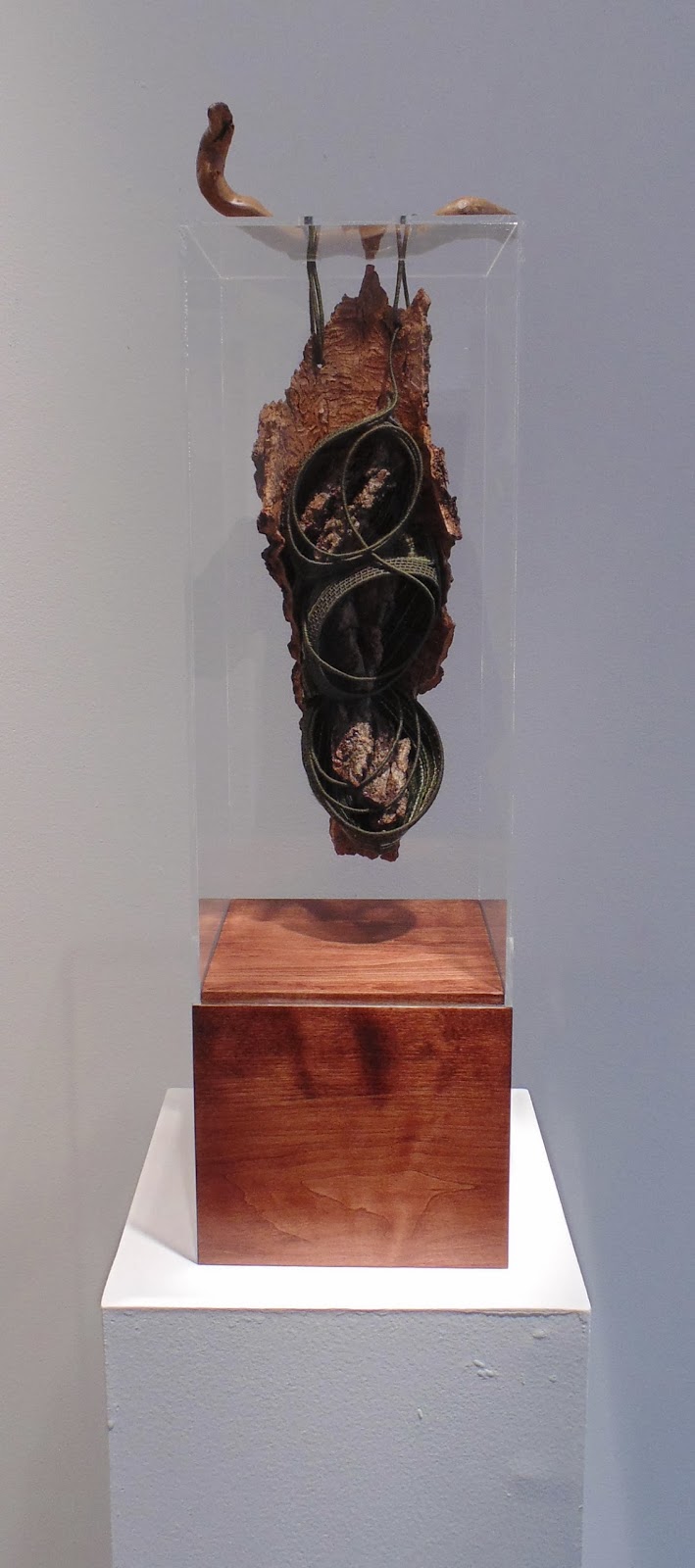
Char Norman, The Naked Truth.
Mixed Media: linen, flax, tree bark. 29 1/2 x 8 1/2 x 8 inches
Where Malec-Kosak's image is more disturbing than not, Norman's The Naked Tree keeps the viewer slipping back and forth between aesthetic beauty and the meaning of the natural forces that produce it. 

This sculpture could very well be interpreted as a reliquary, or any object of veneration. In this piece, Norman has taken extreme care to use natural materials polished and manipulated so their native beauties stand out. Suspended from the stick, finished and polished to such a degree that it looks like bronze, the beautiful cocoon dangles, its exterior is made of bark from an ash tree. The tunneling of ash borer beetles, which have gone far to kill off the tree species, is in plentiful evidence inside the "skin." Those whimsical tunnels are reflected in the woven fiber rope that loops and fills the split cocoon. Like the tree, it is blasted—beautiful, but killed by being opened. 

Nakedness is exposure, and those intimacies—the beetle in the bark, our examination of the interior of this "cocoon"—are killing. The Naked Tree is one of the most exquisite works in this show. It's as elegiac as it is beautiful.
Kathy McGhee, Cottonwood Stand
Intaglio -- photogravure using 2 polymer
 plates. 
Framed: 14 x 12 1/4 inches
 (image: 5 1/2 x 3 3/4 inches).
Photographed under plexiglass.

Kathy McGhee uses trees to exemplify nakedness in a way we know from Shakespeare's Sonnet 73:

That time of year thou mayst in me behold 
When yellow leaves, or none, or few, do hang
Upon those boughs which shake against the cold, 
Bare ruin'd choirs, where late the sweet birds sang. 


The naked boughs in the layered photogravure, Cottonwood Stand, form an elegant image in which each branch is in intimate, organic relationship to all the others. There appear to be systems real and reflected, all affecting one another.

What is the idea of nakedness in McGhee's print? The leaves have gone from the trees, yet being stripped, the trees don't appear vulnerable, inappropriately exposed, or reduced to a final layer. Rather we have a richly built-up image, graceful and complex. If it is naked, it is so in the way of the anatomical invisible man demonstrated in layers of transparencies. His nakedness reveals everything about him in full and specific detail, showing him at his most complex when unclothed.
Susan Li O'Connor. Inkblot No. PA150004
Microns black technical pen on Bristol board and vellum
14 x 17 inches

There are many more artists well worth discussing in Naked. I was very taken, for instance, by a series of drawings by Susan Li O'Connor—black ink on board with ink on vellum in one or two layers on top. The cellular, organic quality of the forms and the floating, receding aspect of the vellum layers are both beautiful and suggestive of microscopic life. The relationship of these images to the theme of "naked" would be worth the poetry I expect to be found at the end of further consideration.

The catalogue to Naked includes statements from the artists regarding their work in this show. I don't recommend that the visitor refer to these as aids in viewing the show, for I find that artists' comments are usually much more limiting than helpful to visitors who bring any of their own viewing history to the show.

Many of the artists tell us what their work is about or why they made it. No doubt they give truthful accounts. But when an artist tells us about specific references, and how they interpret their own work, they tell us what they are to have let go of in presenting completed work. It's for the public to interpret now. 
Julie Taggart, Bye, Baby Bunting
Oil on panel, Framed: 7 1/4 x 7 1/4 inches,
(image: 6 x 6 inches)

"It is more serious in tone and explores what it means to be psychologically naked in the presence of political propaganda; the figure is turned away to our left and trying to ignore the bluster around her..." "The white crosses I use are partly inspired by A Monument to Betty, which is a large white cross on a hill overlooking Nelsonville, Ohio, that was at one time billed as the world's largest freestanding cross. The environments suggest a world formed by our unending thirst for fossil fuels."

While these comments may be of background interest, statements like these risk being reductive. And, ultimately, do they matter to our experience of the works?

If the artists were driven by narrative or expositional ends, did they make the works as illustrations to help articulate their ideas? Was there discovery in the process? Can we find it? If not, much better to leave us to our own imaginations, references, and stories, attaching each piece to the theme as we examine and interpret works with the independent eyes and minds that one hopes all viewers bring to the gallery. Artists' stories count, but they shouldn't lead our first impressions. It's up to viewers to speak to artists, who often can't see what they have in fact done. Artists often miss how richly they affect the minds of viewers, even when it's in ways they did not set out to achieve.